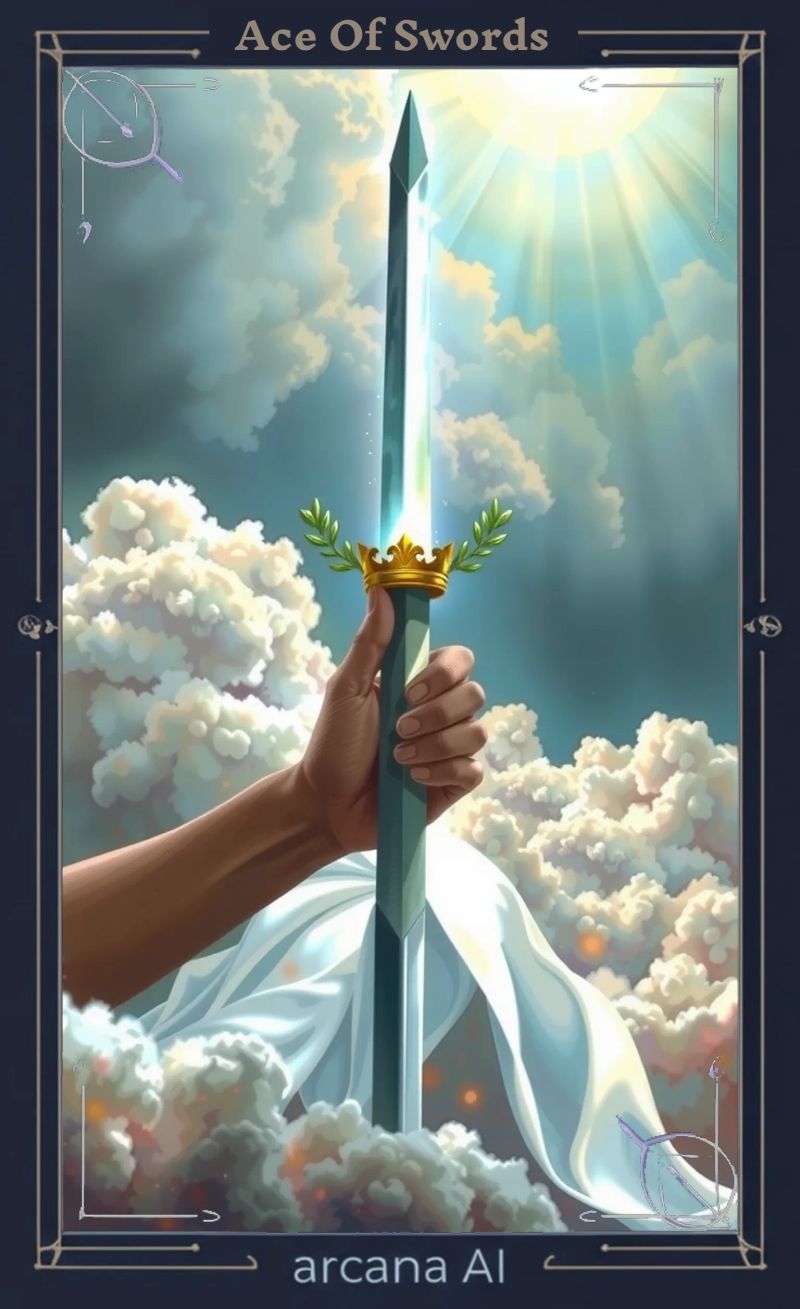
The Ace of Swords represents the raw, concentrated essence of the Air element, personifying mental clarity, radical truth, discernment, and breakthrough intellect. As the root of the suit of Swords, this card marks the moment an idea pierces through confusion like a double-edged blade. It signals a breakthrough in perception: illusions shatter, emotional rationalizations fall away, and you see reality with uncompromising precision. This is not passive contemplation, but active intellectual courage that cuts through pretense to reveal truth.
Position in the Deck
Minor Arcana - Swords Suit - The Ace represents the primordial seed of elemental Air. It governs the realm of thought, analytical reasoning, communication, ethical justice, and the psychological courage required to face reality without defensive distortions.
Upright Meaning
In an upright position, the Ace of Swords signifies intellectual breakthroughs, piercing clarity, honest communication, ethical justice, and decisive action. When this card appears, the fog of indecision lifts. You grasp the core facts of your situation and possess the mental fortitude to articulate them clearly. It calls you to champion fairness, cut through ambiguity, and trust your analytical faculties to resolve complex challenges.
Practical Applications:
- Cut through procrastination by making clean, definitive decisions based on verified facts
- Express your thoughts with direct honesty, eliminating passive-aggressive ambiguity
- Challenge unexamined assumptions and seek objective evidence before drawing conclusions
- Stand up for ethical fairness, contractual integrity, and moral principles in disputes
- Channel mental focus into rigorous study, strategic writing, or conceptual design
Love and Relationships (Upright)
In relationship readings, the Ace of Swords brings refreshing honesty and vital boundary work. If you and your partner have navigated unspoken tensions or passive avoidance, this card signals an honest conversation that clears the air. Mutual respect deepens when both individuals communicate their authentic needs without manipulative drama. For single individuals, it denotes cutting emotional ties with past partners and gaining crisp clarity on what you require in an equal, transparent partnership.
Career and Finances (Upright)
Professionally, the Ace of Swords is a powerful herald of intellectual victory. It indicates successful negotiations, decisive contract signing, creative problem-solving, and the breakthrough realization that unlocks a stalled project. In financial matters, it advises eliminating speculative illusions, cutting wasteful expenditures, and establishing a logical, auditable budget.
Reversed Meaning
When reversed, the Ace of Swords warns of mental confusion, cruel communication, intellectual arrogance, or denial of uncomfortable facts. The double-edged blade turns inward or is wielded destructively: you may use intellect as a weapon to demean others, or hide behind endless rationalizations to avoid facing a painful reality. It also signals cognitive overload, brain fog, and chaotic ideas that lack structure or practical execution.
Challenges and Warnings:
- Guard against biting sarcasm, hostility, or using superior intellect to belittle others
- Notice where you refuse to accept obvious evidence because it contradicts your pride
- Pause before making irreversible decisions while your mind feels scrambled or emotionally agitated
- Avoid getting trapped in analysis paralysis where endless critique replaces meaningful action
- Seek second opinions from trusted colleagues to check your intellectual blind spots
Love and Relationships (Reversed)
In romantic contexts, the reversed Ace of Swords warns of verbal aggression, cold emotional detachment, and misunderstandings that escalate through blunt, hurtful speech. One partner may use logic as a defensive shield to invalidate the other person’s legitimate feelings. Alternatively, it reflects lingering dishonesty or secret resentments that fester beneath polite facades. Healing requires softening the intellect with empathy and choosing constructive dialogue over winning arguments.
Career and Finances (Reversed)
In professional matters, the reversed card alerts you to flawed logic, misleading metrics, contracts with deceptive fine print, and communication breakdowns within teams. Guard against premature announcements or launching products before testing their conceptual validity. Financially, beware of schemes that sound brilliantly complex but hide substantial risk under sophisticated jargon.
Psychological Archetype and Shadow Dynamics
In the framework of Carl Gustav Jung’s analytical psychology, the Ace of Swords embodies the Logos Principle and the Archetype of Intellectual Discernment. It represents the conscious ego’s capacity for discrimination, separating subject from object, truth from projection, and fact from emotional sentimentality.
The sword emerges from a cloud, showing that true intellectual insight often arrives unbidden from the unconscious mind. Like an epiphanic spark, it reorders the conscious mind in an instant. However, this sword is double-edged: it cuts away ignorance, but can also sever empathy if divorced from the feeling function.
In shadow work, the Ace of Swords highlights two defensive distortions:
- The Hyper-Rational Tyrant: The individual who uses intellect as a defense mechanism against emotional vulnerability. They dismiss emotions as irrational weaknesses, reducing intimate human dilemmas to cold clinical problems.
- Willful Blindness: The individual who senses the truth but suppresses conscious awareness because acknowledging it would destroy a comfortable illusion or demand costly lifestyle changes.
Integrating the shadow of the Ace of Swords requires harmonizing intellectual clarity with emotional empathy: wielding the sword of truth to liberate yourself and others, never to wound gratuitously.
Symbolic Elements
The Single Double-Edged Blade: Points directly upward to the heavens, representing the singular focus of truth and the power of human intellect aligned with higher ethical principles. The two sharp edges show that truth cuts both ways, holding the speaker to the same standard required of others.
The Hand Emerging from the Cloud: A luminous right hand emerges from an immaculate white cloud, symbolizing divine illumination and the unconscious origin of sudden creative inspiration.
The Golden Crown at the Tip: The blade passes through a royal golden crown, signifying the ultimate sovereignty of truth over political power, ego, and worldly ambition.
The Palm and Olive Branches: Draped across the crown, the olive branch represents peace, while the palm frond symbolizes victory and spiritual enduring life. Truth does not seek destruction: its proper purpose is enduring peace through justice.
The Six Yod-Shaped Droplets: Luminous golden sparks fall around the blade, echoing the Hebrew letter Yod. They represent divine grace and spiritual vitality descending into the material plane whenever truth is spoken.
The Rugged Mountain Peaks: Barren blue and gray summits frame the bottom horizon, showing that the path of mental clarity is rigorous, objective, and elevated above the humid valleys of emotional confusion.
Color Symbolism:
- Sky Gray and White: Impartiality, clarity, intellectual neutrality, and mental discipline
- Gold (crown and droplets): Wisdom, sovereign authority, and enduring value
- Steel Blue (mountains and blade): Focus, coolness of intellect, and emotional calm
Historical and Esoteric Context
The iconography of the Ace of Swords draws from ancient legal, biblical, and philosophical roots:
- The Sword of Damocles and King Solomon: Solomon’s judgment demonstrated the sword as an instrument of psychological truth and moral discernment rather than mere violence.
- The Kabbalistic Kether of Yetzirah: In the Hermetic Order of the Golden Dawn, the Ace of Swords corresponds to the primordial Crown (Kether) in the formative world of intellect and communication (Yetzirah).
- Alchemical Separation: In alchemy, the sword represents separatio, the critical stage of isolating pure elements from contaminated matter to allow transformation.
Card Interactions
With The Magician: Merges raw intellectual clarity with the practical tools needed to manifest ideas into concrete form. With Justice: Amplifies ethical integrity, legal triumph, objective fairness, and unbiased resolution of disputes. With The Hermit: Directs mental focus inward toward deep philosophical study, solitary research, and personal introspection. With The Tower: Signals a sudden, shocking revelation of truth that shatters established illusions overnight. With The Two of Swords: Represents the breakthrough moment when the blindfold is removed and an unresolved stalemate must finally be decided.
Elemental and Astrological Correspondences
Element: Air (intellect, analytical reasoning, communication, discernment) Astrological Association: The Air Triplicity (Gemini, Libra, Aquarius) Decanate: Governs the celestial quadrant associated with the root power of intellectual Air Associated Deities: Athena (Greek goddess of strategic wisdom and justice), Thoth (Egyptian patron of writing and scientific measurement), and Ma’at (goddess of cosmic balance and truth)
Esoteric Meanings
In Western esoteric traditions, the Ace of Swords signifies:
- The birth of conscious awareness and the power to name reality
- The spiritual blade that cuts the cords of karmic attachment and illusion
- The primal authority of the spoken word aligned with universal law
- The sword of spiritual discernment guarding the gateway to the Tree of Life
- The realization that truth is liberating even when its initial impact brings discomfort
Contemplative Journaling Prompts
- What uncomfortable truth am I currently avoiding because naming it would require me to take action?
- How can I express my honest boundaries without using harsh or defensive language?
- Where in my life am I substituting over-analysis for courage and direct execution?
- If I stripped away everyone else’s expectations, what is the single most honest next step for me?
Frequently Asked Questions about the Ace of Swords
What does the Ace of Swords mean in a love reading?
Upright, it indicates an important breakthrough conversation that clears misunderstandings, sets healthy boundaries, and establishes genuine honesty. It cuts through passive-aggressive tension. Reversed, it warns of verbal hostility, cold detachment, or refusing to face facts about an incompatible partner.
Is the Ace of Swords a ‘yes’ or ‘no’ card?
In yes-or-no readings, the Ace of Swords is a decisive YES. It signals that objective facts and mental clarity support your direction. However, it requires direct action, clear communication, and personal accountability.
What should I do when the Ace of Swords appears in a career reading?
Take decisive initiative. Draft the proposal, negotiate terms with clear documentation, speak candidly with stakeholders, and base your strategy on audited data rather than optimistic speculation.
Why does the Ace of Swords feature a crown pierced by a blade?
The sword piercing through the crown symbolizes that ultimate authority belongs to objective truth rather than personal ego or worldly status. Genuine power and lasting peace come from aligning your mind with truth.