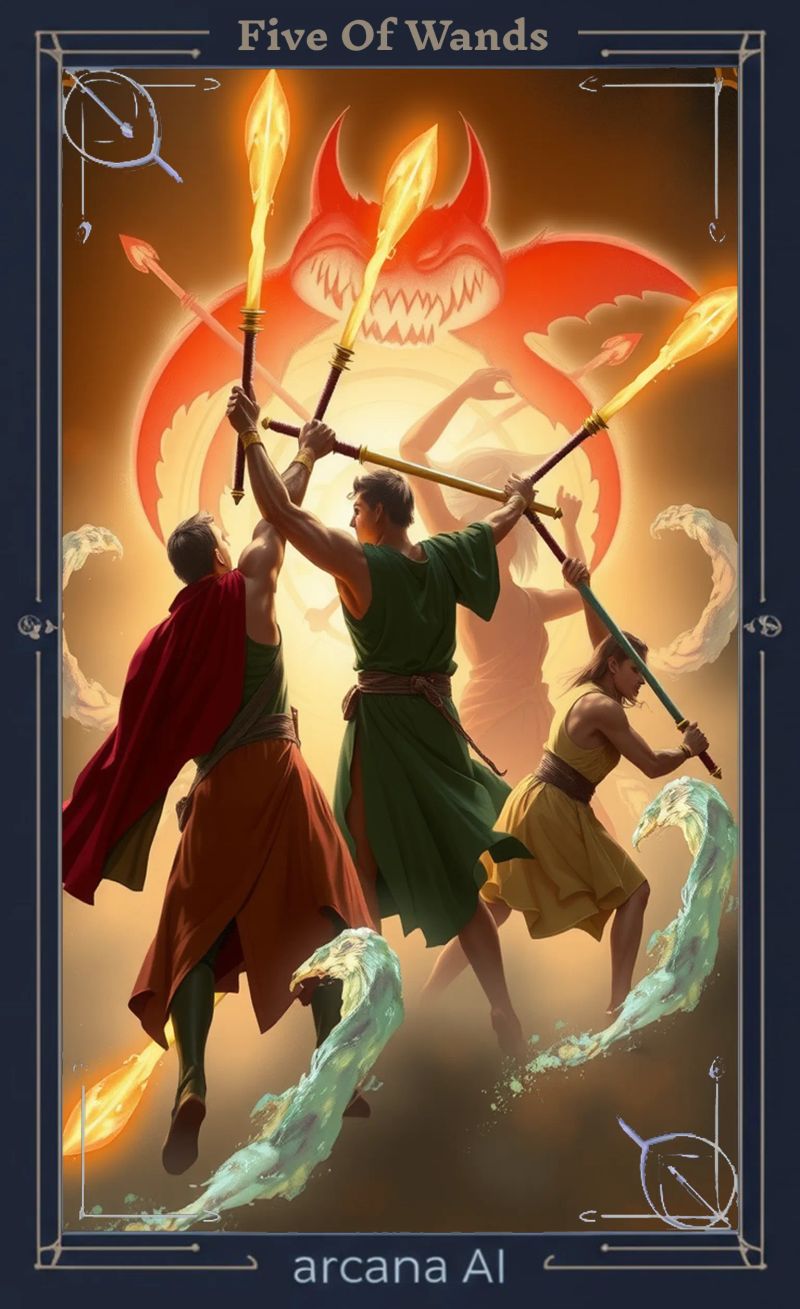
The Five of Wands represents dynamic tension, competitive friction, conflicting agendas, and the vigorous testing of individual willpower. In the tarot narrative, the harmony and celebration established in the Four of Wands gives way to the disruptive instability inherent to the number five. Five youths brandish wooden staves in an open field, clashing in what appears to be mock combat rather than mortal warfare. This card illustrates the vital crucible of friction: healthy debate, competitive testing, and the challenges that arise when multiple passionate perspectives vie for dominance.
Position in the Deck
Minor Arcana - Wands Suit - Card 5 in the suit of Fire. Fives introduce disruption, trial, and the breakdown of established structures across the Minor Arcana. In Wands, this disruption manifests as interpersonal rivalry, conflicting passions, creative friction, and the struggle to establish leadership.
Upright Meaning
In an upright position, the Five of Wands signifies healthy competition, creative debate, conflicting priorities, active struggle, and clashing egos. It indicates an environment where everyone has an opinion and no single authority figures as sovereign. While the noise and agitation can feel chaotic, this is not fatal combat: it is a sparring match designed to test strength, sharpen arguments, and refine strategies before real battles occur.
Practical Applications:
- Welcome constructive pushback from teammates to stress-test your ideas before launching
- Participate actively in brainstorming sessions without taking disagreements personally
- Sharpen your skills by measuring yourself against worthy competitors in your industry
- Channel restlessness into athletics, public speaking, or disciplined debate
- Establish clear rules of engagement so spirited competition does not devolve into personal animosity
Love and Relationships (Upright)
In relationship readings, the Five of Wands highlights bickering, competitive ego-clashing, and small daily annoyances that produce friction between partners. Neither person wants to yield, turning minor decisions (chores, schedules, social outings) into stubborn tugs-of-war. However, this friction often points to lively passion rather than fundamental incompatibility. If both partners learn to fight fair, acknowledge their differences, and laugh at their stubbornness, this stage clears the air. For singles, it reflects a crowded dating scene where multiple suitors compete for attention.
Career and Finances (Upright)
Professionally, this card denotes a bustling, competitive environment: pitch meetings with rival agencies, multiple candidates interviewing for a single promotion, or a team where talented contributors argue over creative direction. Success requires preparing thoroughly, stating your case persuasively, and maintaining professional composure while others lose their tempers. Financially, it warns of volatile market fluctuations, competing bids, or conflicting advice from financial planners that demands critical discernment.
Reversed Meaning
When reversed, the Five of Wands points to exhausting inner turmoil, conflict avoidance, dirty competition, or the welcome cessation of hostility. In its constructive manifestation, it signals that disputes have exhausted themselves: team members lay down their staves, seek compromise, and agree to collaborative terms. In its shadow manifestation, it reveals passive-aggressive sabotage, underhanded office politics, or individuals who bottle up legitimate grievances out of conflict phobia until resentment poisons the relationship.
Challenges and Warnings:
- Notice where you are avoiding a necessary confrontation to preserve an artificial peace
- Beware of colleagues or rivals who smile publicly while undermining your efforts behind closed doors
- Refuse to waste precious energy on petty, inconsequential arguments that lead nowhere
- Address the internal civil war between your conflicting desires before making commitments
- Step away from toxic group dynamics where hostility is chronic and unproductive
Love and Relationships (Reversed)
In romantic contexts, the reversed Five of Wands can indicate a truce: partners stop picking fights over trivial matters and commit to collaborative listening. However, it can also signal the silent treatment, cold emotional withdrawal, and deep resentment that neither person is willing to address aloud. For single individuals, it reflects fatigue with competitive modern dating culture and a desire to step back and re-evaluate personal boundaries.
Career and Finances (Reversed)
In the workplace, the reversed card warns of covert sabotage, unfair competition, or legal arbitration replacing informal discussion. Alternatively, it marks the end of a grueling competitive phase: contracts are awarded, internal reorganizations stabilize, and teams move from arguing into collaborative execution. Financially, it suggests settling contested debts, legal settlements, or reaching compromise over disputed inheritances or contract fees.
Psychological Archetype and Shadow Dynamics
In Carl Gustav Jung’s analytical psychology, the Five of Wands personifies the Archetype of the Agon (the sacred contest) and the Internal Civil War of Fragmented Ego Drives.
The five youths battling in the field represent conflicting sub-personalities within a single psyche: ambition fighting against fear of exposure, the desire for independence warring with the need for belonging, and primal instinct challenging conscious morality. Because none of the youths wear armor or inflict lethal wounds, this struggle is psychic sparring: the psyche’s instinctive method of testing its capacities before crystallization.
In shadow work, the Five of Wands uncovers two defensive adaptations:
- The Compulsive Combatant: The individual who equates peace with vulnerability. They pick fights compulsively, manufacture crises, and view every conversation as a power struggle because feeling embattled keeps their adrenaline pumping and distracts from core insecurity.
- The Conflict-Phobic Placater: The person who terrified of anger or disapproval suppresses all dissenting opinions, smiles compliantly, and allows others to override their boundaries, cultivating deep latent resentment.
Integrating the shadow of the Five of Wands requires learning how to engage in clean, conscious conflict: speaking your truth firmly, respecting worthy opponents, and recognizing that friction is a natural law of growth rather than a catastrophic failure.
Symbolic Elements
The Five Youths with Raised Staves: Five young men wield rough-hewn wooden wands at varying angles, creating a crisscrossing thicket of energy. None of the staves make contact with human flesh, and no blood is drawn, confirming that this is mock warfare, athletic competition, or a trial of skill.
The Mismatched, Multi-Colored Tunics: Each figure wears distinct garments in vibrant yellow, red, blue, green, and orange. This sartorial diversity symbolizes conflicting personal backgrounds, differing value systems, and the clash of individual perspectives within a collective.
The Unmarked, Open Meadow: The conflict unfolds on wild green terrain without fencing, chalk lines, or demarcated borders. This shows that the struggle is unstructured and spontaneous, lacking an established referee or institutional guidelines.
The Absence of Armor and Lethal Weapons: Unlike the swords in the suit of Air, the wooden wands represent creative and vital energy rather than lethal violence. The participants fight bare-headed in light tunics, emphasizing energy, agility, and enthusiasm over malice.
Color Symbolism:
- Green (ground and foliage): Vitality, natural growth, fertility, and developmental potential
- Yellow and Gold (tunics and light): Intellectual stimulation, creative consciousness, and vitality
- Red and Orange (garments): Fire element, competitive passion, pride, and active ambition
- Blue (sky): Clear mental horizon, reminding the observer that the chaos is temporary
Historical and Esoteric Context
The visual and conceptual heritage of the Five of Wands combines chivalric sports, astrology, and Hermetic symbolism:
- Chivalric Tournaments and Pas d’Armes: In medieval European martial culture, young squires engaged in bastonade (combat with wooden staves) to master balance, reflexes, and tactics without risking life and limb before entering real warfare.
- Saturn in Leo (The Astrological Decan): In the Golden Dawn tradition, the Five of Wands is titled the “Lord of Strife.” It corresponds to the first decan of Leo, ruled by Saturn. This placement represents Saturnian restriction and heavy friction colliding with Leo’s fiery pride and vitality, producing intense struggle and contested willpower.
- The Kabbalistic Geburah of Atziluth: Represents the fifth Sephirah (Geburah, Severity and Judgment) in the archetypal world of Fire (Atziluth). Geburah brings correction, friction, and purification to the harmonious equilibrium of the previous sphere.
Card Interactions
With The Chariot: Shows that diffuse, scattered competition can be brought under control through focused willpower, strategic leadership, and disciplined direction. With The Three of Pentacles: Marks the transition from chaotic, unproductive arguing to structured, collaborative teamwork where each contributor’s skill is respected. With The Five of Swords: A severe warning that playful or constructive competition is in danger of degenerating into malicious, vindictive combat where winning at all costs ruins relationships. With The Hierophant: Indicates conflicts that arise from challenging orthodox rules, institutional dogma, or established authority figures. With The Two of Cups: Resolves petty bickering between partners through genuine vulnerability, reconciliation, and mutual affection.
Elemental and Astrological Correspondences
Element: Fire (passion, ambition, rivalry, assertive action) Astrological Decan: First Decan of Leo (0° to 10° Leo) Planetary Ruler of Decan: Saturn in Leo Kabbalistic Sephirah: Geburah (Strength, Severity, Disruption) in the World of Atziluth (Fire) Associated Mythological Figures: The Greek Agon (personification of contest and athletic competition), Mars/Ares in his youthful sporting aspect, and the tournament squires of chivalric legend
Esoteric Meanings
In the Hermetic and occult mystery schools, the Five of Wands signifies:
- The necessary disruption that prevents stability from ossifying into stagnation
- The friction of the manifest world testing the purity of the initiate’s initial vision
- The alchemical crucible where raw passions clash to produce refined consciousness
- The trial of courage wherein the ego learns humility through encountering equal forces
- The recognition that spiritual growth requires active engagement with challenge, not passive withdrawal
Contemplative Journaling Prompts
- What minor disagreement am I currently escalating into an unnecessary battle of egos?
- Where am I avoiding healthy conflict because I am afraid of other people’s anger or disapproval?
- How can I express my creative vision passionately while remaining genuinely open to other perspectives?
- If I stopped viewing my colleagues or peers as rivals, what collaborative opportunities would emerge?
Frequently Asked Questions about the Five of Wands
Does the Five of Wands mean a real fight or breakup in love?
Usually, no. It rarely points to malicious hostility or final breakups. Instead, it reflects daily friction, competitive bickering, and temporary clashes of wills where neither partner wants to concede. It calls for fair communication rules and a sense of humor rather than panic.
Is the Five of Wands a ‘yes’ or ‘no’ card?
In yes-or-no readings, the Five of Wands leans toward NO or NOT YET. It indicates that the path forward is congested with competition, conflicting priorities, or unresolved disagreements that must be navigated before clear progress is possible.
How should I handle the Five of Wands at work?
Focus on preparation, clarity, and emotional detachment. Expect debate, welcoming critical feedback to improve your work. Avoid participating in petty office gossip or territorial drama: let your competence and composure speak for you.
What is the difference between the Five of Wands and the Five of Swords?
The Five of Wands is playful, athletic, or creative friction without malice (mock combat with wooden staves). The Five of Swords is malicious, cynical conflict fought with sharp steel blades, where one person triumphs through deception, cruelty, or leaving others humiliated.