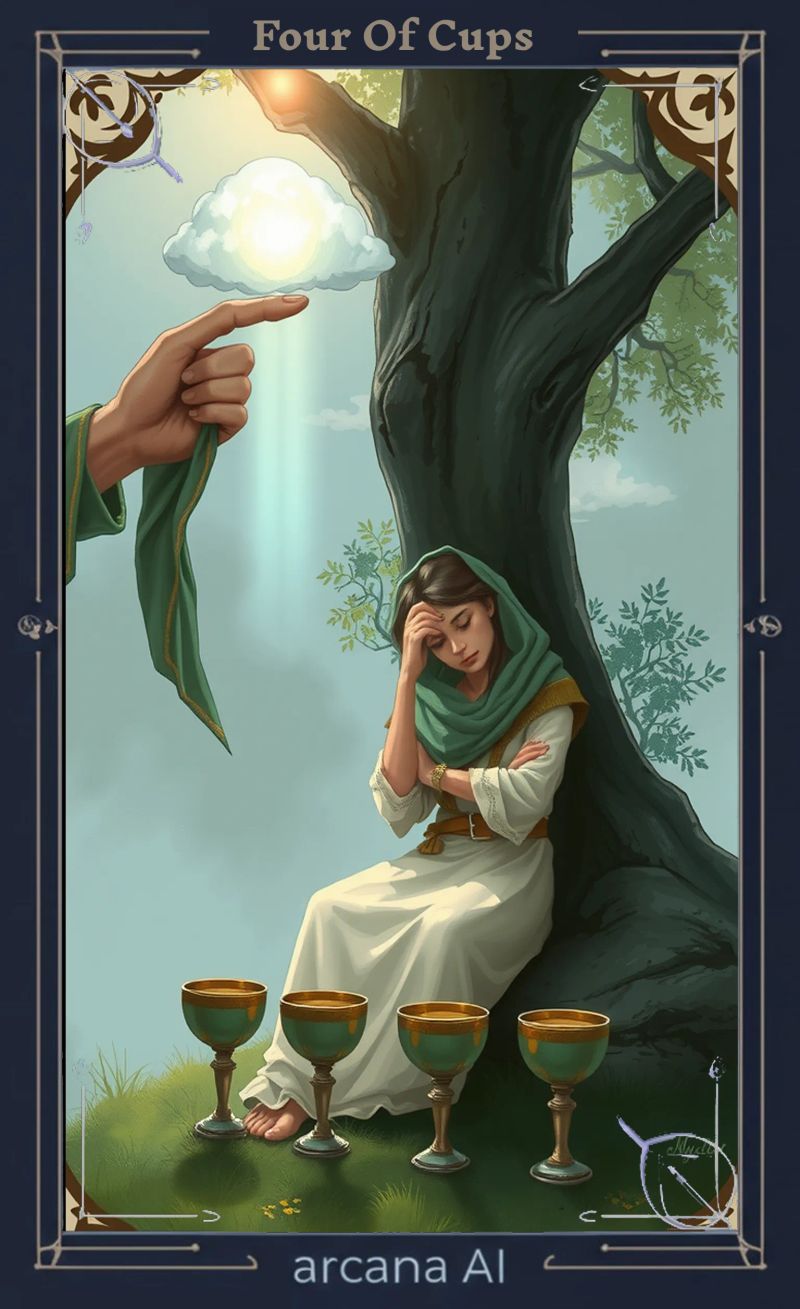
The Four of Cups represents emotional saturation, meditative withdrawal, spiritual apathy (acedia), and the quiet danger of overlooking blessings while lost in brooding contemplation. In the suit of Cups, after the celebratory fellowship of the Three, the number four introduces containment, consolidation, and emotional stagnation. A young person sits beneath a green tree on a grassy hillock, arms firmly folded and eyes cast downward toward three golden cups resting on the earth. Meanwhile, a divine hand emerges from a cloud, holding forth a fourth cup in mid-air. This card captures the psychological state of divine discontent: the familiar has grown stale, yet pride or emotional exhaustion prevents you from reaching out for new grace.
Position in the Deck
Minor Arcana - Cups Suit - Card 4 of the suit of Water. The number four represents boundary, form, and stability. When applied to the fluid element of Water, excessive containment creates a stagnant pond where emotional energy ceases to flow, leading to apathy, boredom, and introspective isolation.
Upright Meaning
In an upright position, the Four of Cups signifies apathy, emotional withdrawal, boredom, divine discontent, and missed opportunities. It appears when you feel uninspired by your current achievements or relationships: what once brought joy now feels repetitive and routine. You may find yourself staring sullenly at your circumstances, dwelling on what is missing rather than noticing the unexpected gift, invitation, or olive branch being held out to you from an unexpected direction. It is a compassionate call to awaken from self-absorbed brooding.
Practical Applications:
- Look up from your phone, routine, or grievances to notice subtle opportunities presenting themselves
- Practice active gratitude by deliberately writing down three specific blessings you are taking for granted
- Acknowledge your boredom or discontent as a signal that your soul desires deeper spiritual purpose
- Decline invitations that drain your soul, but avoid shutting out genuine friends who wish to support you
- Shift your physical environment: take a walk in nature, change your workspace, or try a new activity
Love and Relationships (Upright)
In relationship readings, the Four of Cups highlights emotional complacency and withdrawal. One partner may feel unappreciated or take the relationship for granted, treating their companion with indifference. Minor flaws are magnified, while loving gestures are ignored. It can also describe someone sulking after a disagreement, holding onto hurt pride with folded arms. For single individuals, it indicates turning down genuine romantic suitors because they do not match an impossible, fairy-tale checklist, or feeling too emotionally burnt out to make an effort.
Career and Finances (Upright)
Professionally, this card reflects severe workplace boredom, career plateaus, and demotivation. You may have achieved the title or stability you once sought, only to discover that it feels hollow and unfulfilling. You risk missing promotions, exciting collaborations, or innovative assignments because your eyes are glued to your frustrations. Financially, it advises against apathy in managing money: review your bank statements, cancel unused subscriptions, and avoid letting discontent lead to retail therapy.
Reversed Meaning
When reversed, the Four of Cups heralds a revival of motivation, breaking out of an emotional slump, recognizing overlooked opportunities, and re-engaging with life. The fog of lethargy begins to lift. You suddenly realize that you have spent enough time sulking under the tree: you uncross your arms, look up, and gratefully accept the cup being offered by life. In its shadow form, it warns of impulsive overcompensation: frantically saying yes to every distraction or social invitation just to escape feelings of inner emptiness.
Challenges and Warnings:
- Seize the new opportunity presenting itself before the window of availability closes
- Do not let past disappointments convince you that all future possibilities are flawed
- Balance your renewed social enthusiasm with periods of grounded self-reflection
- Forgive yourself for the time you spent in stagnation: emotional incubation is part of growth
- Accept constructive help and emotional support without defensive cynicism
Love and Relationships (Reversed)
In romantic contexts, the reversed Four of Cups indicates an emotional breakthrough. Partners drop defensive walls, cease the silent treatment, and welcome each other back with tenderness and refreshed appreciation. For single individuals, it signals leaving your emotional fortress: you stop dwelling on past heartbreaks, delete self-pitying narratives, and actively open yourself to dates, social events, and romantic vulnerability.
Career and Finances (Reversed)
In the workplace, the reversed card signals a surge of fresh enthusiasm. A boring assignment reveals unexpected creative potential, or an intriguing job offer lands in your inbox that you eagerly accept. You reconnect with professional ambition and actively participate in team meetings. Financially, it marks taking active control of your finances, seeking wise investment counsel, and finding creative ways to build abundance.
Psychological Archetype and Shadow Dynamics
In Carl Gustav Jung’s analytical psychology, the Four of Cups embodies the Midday Demon (Acedia) and the Archetype of the Wounded Contemplative.
The seated youth with arms crossed across his chest portrays the ego in a state of psychic resistance: the anima (the feeling function) has retreated into the unconscious. The three cups on the grass represent past emotional experiences that have been fully assimilated and therefore no longer stimulate the psyche. The fourth cup extended from the cloud represents the Transcendent Function: a novel symbol or psychic impulse offered by the Self to bridge the gap between conscious boredom and unconscious depth.
In shadow work, the Four of Cups illuminates two defensive adaptations:
- The Professional Brooder (Narcissistic Anhedonia): The individual who adopts melancholy as an aesthetic or moral badge of honor. They believe that enjoying ordinary life is vulgar, dismissing simple pleasures and affection as beneath their sophisticated standards to avoid the messy risks of intimacy.
- The Chronic Victim of Disillusionment: The person who projects impossible perfection onto people and jobs, and then uses inevitable human imperfection as an excuse to withdraw into haughty, self-pitying isolation.
Integrating the shadow of the Four of Cups requires recognizing that emotional nourishment does not force itself upon you: it must be actively accepted. Unfolding your arms is a spiritual act of humility that allows grace to enter.
Symbolic Elements
The Seated Youth with Crossed Arms and Legs: Sits under a canopy of leaves with limbs tightly folded. His posture signifies defensive closure, emotional withdrawal, refusal to interact, and physical stagnation.
The Three Cups Standing on the Lawn: Three golden chalices stand upright before him, untouched and unacknowledged. They represent past relationships, established successes, and everyday blessings that have lost their novelty and are being taken for granted.
The Fourth Cup Offered from the Cloud: A luminous hand emerges from a white cloud holding a fourth cup at eye level. This is the unexpected gift of grace, a new emotional path, or an inspired opportunity that the youth fails to see because his gaze is locked on the ground.
The Sturdy Tree and Grassy Mound: The youth rests against the trunk of a leafy tree on an elevated mound, symbolizing physical protection, organic roots, and natural shelter. The setting is peaceful, confirming that his misery is entirely internal and self-generated.
Color Symbolism:
- Sky Gray and Cloud White: Emotional neutrality, suspended judgment, and transpersonal spiritual origin
- Leaf Green and Earth Brown: Natural fertility, patience, and grounded physical shelter
- Deep Blue (clothing): Rich emotional and intuitive interiority that has turned inward
- Gold (chalices): Divine worth, spiritual opportunity, and precious emotional value
Historical and Esoteric Context
The visual and conceptual heritage of the Four of Cups connects medieval monastic literature with astrological decans:
- Acedia in Monasticism: In Christian desert monasticism (Evagrius Ponticus), acedia was the “noonday demon” that tempted monks to despair of their vocation, viewing their cell, prayers, and brothers with utter distaste. The cure was not flight, but steadfast presence.
- The Moon in Cancer (The Astrological Decan): In the Hermetic Order of the Golden Dawn, this card is titled the “Lord of Blended Pleasure.” It corresponds to the third decan of Cancer, ruled by the Moon. The Moon in Cancer resides in its domicile: emotional fullness and excessive comfort turn inward, generating satiety, emotional withdrawal, and deep contemplation.
- The Kabbalistic Chesed of Briah: Represents the fourth Sephirah (Chesed, Mercy and Receptive Containment) in the creative world of Water (Briah). Too much containment creates a dammed reservoir where fresh waters cannot circulate.
Card Interactions
With The Ace of Cups: The fourth cup offered in the Four of Cups is identical to the chalice in the Ace: accepting it initiates a complete emotional and spiritual rebirth. With The Hermit: Shows that solitary contemplation can be either a sacred pursuit of wisdom (Hermit) or a stubborn, sulking withdrawal (Four of Cups), urging the seeker toward light. With The Three of Cups: Represents the sharp psychological contrast between the joy of collective fellowship and the lonely brooding of self-imposed isolation. With The Eight of Cups: The natural evolution if apathy persists: when the cups truly run dry, you must rise, turn your back on the old life, and walk away into the mountains. With The Sun: Breaks through the fog of discontent with blinding warmth, restoring vibrant joy, laughter, and appreciation for life.
Elemental and Astrological Correspondences
Element: Water (feelings, emotional stagnation, internal brooding, intuition) Astrological Decan: Third Decan of Cancer (20° to 30° Cancer) Planetary Ruler of Decan: Moon in Cancer Kabbalistic Sephirah: Chesed (Mercy, Form, Stagnant Reservoir) in the World of Briah (Water) Associated Mythological Figures: The brooding Achilles sulking in his tent during the Trojan War, Elijah sitting despondent beneath the broom tree, and Prince Siddhartha contemplating the vanity of worldly palace pleasures
Esoteric Meanings
In Western esoteric and Hermetic mystery traditions, the Four of Cups signifies:
- The spiritual crisis of satiety where material comforts no longer nourish the soul
- The necessary disillusionment that prepares the initiate to seek eternal rather than temporal treasures
- The invisible hand of Providence testing whether the soul has eyes to see divine gifts
- The realization that gratitude is the alchemical key that transforms stagnant water into living wine
- The understanding that peace cannot be found by demanding that the world entertain your ego
Contemplative Journaling Prompts
- What blessing, supportive relationship, or daily comfort am I currently treating with indifference?
- What opportunity is being offered to me right now that I am dismissing because it does not look like my fantasy?
- Where am I using brooding or melancholy as a protective wall to avoid taking emotional risks?
- If I chose to uncross my arms and participate fully in my life today, what would I say yes to?
Frequently Asked Questions about the Four of Cups
What does the Four of Cups mean for my relationship?
It warns of emotional stagnation, taking your partner for granted, or brooding over minor annoyances. It advises breaking out of daily ruts, planning a romantic gesture, and practicing appreciation for your partner’s quiet loyalty.
Is the Four of Cups a ‘yes’ or ‘no’ card?
In yes-or-no readings, the Four of Cups is generally a NO or NOT INTERESTED. It indicates that your heart is not genuinely invested in the proposed course of action, or that you are currently too distracted by discontent to pursue it successfully.
What should I do when I see the hand offering the fourth cup?
Look up and pay attention to subtle synchronicities. An unexpected phone call, a casual job recommendation, or an invitation to an unfamiliar event may be the very opportunity you need to break your slump.
Why does the youth have his arms crossed?
His crossed arms symbolize emotional defensiveness, stubbornness, and closed energy. He is protecting his personal space, but in doing so, he blocks himself from receiving new love, help, and inspiration.