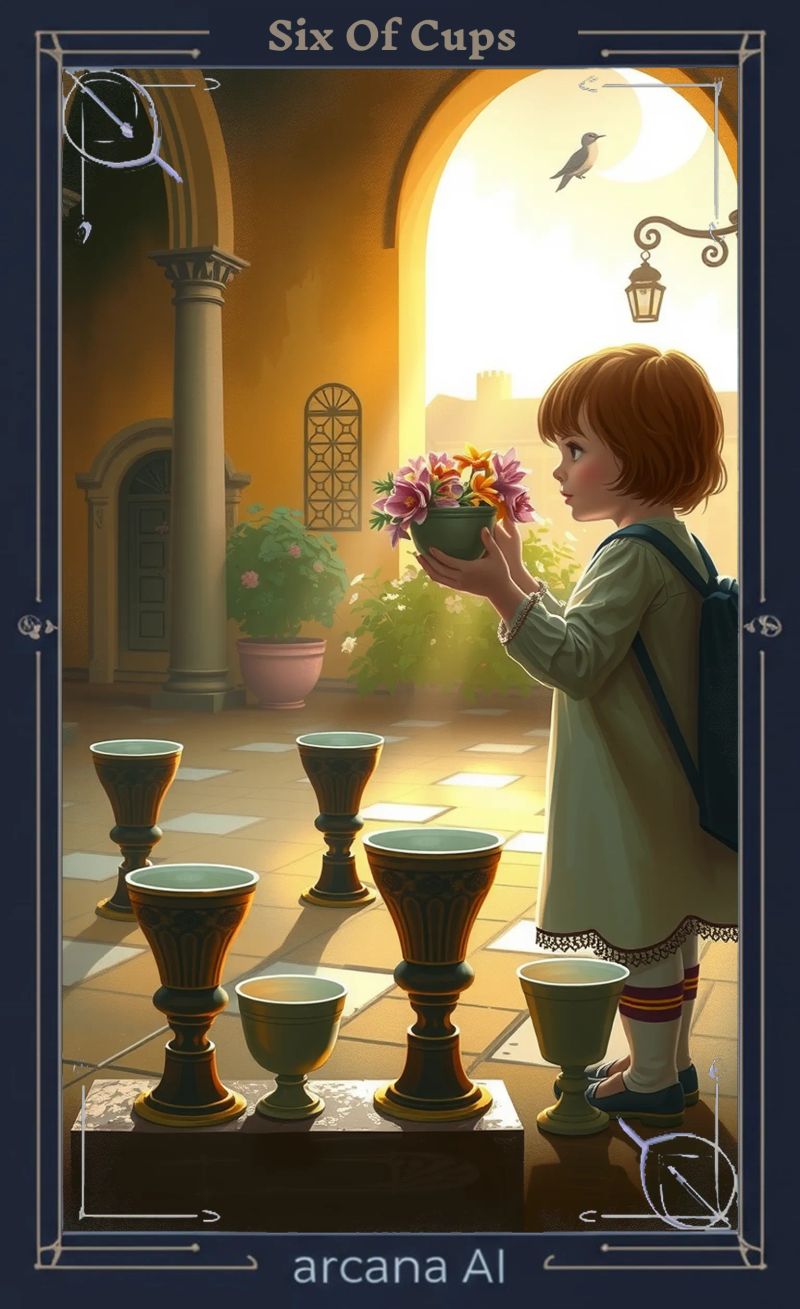
The Six of Cups represents sweet nostalgia, innocent affection, the retrieval of joyful childhood memories, and gentle emotional reconciliation. Following the grief and isolation depicted in the Five of Cups, the emotional narrative of the suit shifts into healing. In an enclosed village courtyard, an older child gently offers a golden cup brimming with white star-like flowers to a younger companion. This card speaks to the pure, uncomplicated emotional exchanges of youth, prompting you to remember who you were before adult cynicism, heartbreak, and social conditioning built walls around your heart.
Position in the Deck
Minor Arcana - Cups Suit - Card 6 in the suit of Water. In tarot numerology, six represents harmony, equilibrium, beauty, and emotional resolution. In Cups, this harmony manifests as the restoration of emotional innocence through the healing power of memory and heartfelt generosity.
Upright Meaning
In an upright position, the Six of Cups signifies nostalgic affection, childhood wonder, reconnecting with the past, innocent gifts, and emotional healing. It surfaces when someone or something from your past resurfaces in a supportive way: a childhood friend, an old passion project, or a past love who returns with genuine tenderness. It encourages you to find comfort in familiar roots and embrace your inner child’s capacity for trust and unconditional love.
Practical Applications:
- Reach out to childhood friends, former mentors, or family members to rekindle fond bonds
- Revisit creative hobbies, games, or artistic outlets that brought you uninhibited joy in youth
- Practice simple acts of kindness, giving without keeping score or expecting return favors
- Forgive old family grievances by understanding the innocence underlying human fallibility
- Allow yourself to feel vulnerable, playful, and emotionally spontaneous in safe environments
Love and Relationships (Upright)
In relationship readings, the Six of Cups is deeply romantic and tender. It often indicates reconnecting with an old flame, childhood sweetheart, or someone with whom you share a profound soul-level familiarity. In established relationships, it points to a period of gentle renewal: couples reminisce about their beginnings, revisit meaningful vacation spots, and treat each other with playful sweetness. It can also signify having children, adopting pets, or creating a nurturing home filled with warmth. For singles, it heralds meeting someone who feels instantly like home.
Career and Finances (Upright)
Professionally, this card suggests returning to a former company, working with trusted long-time colleagues, or turning a childhood passion into a viable career. It favors work in education, childcare, historical preservation, antique trading, and creative arts that evoke emotional resonance. Financially, it frequently indicates family gifts, inheritances, trust funds, or financial assistance from relatives that provides a supportive foundation.
Reversed Meaning
When reversed, the Six of Cups warns of living in the past, idealizing old relationships, refusal to mature, or confronting childhood trauma. In its shadow aspect, it describes someone trapped in a nostalgic prison: wearing rose-colored glasses, pining endlessly for an ex-partner who was actually toxic, or comparing the present unfavorably to “the good old days.” Alternatively, it can signal outgrowing your hometown, leaving behind outdated childhood patterns, and stepping courageously into adult independence.
Challenges and Warnings:
- Stop re-reading old text messages and longing for a romanticized past that never truly existed
- Address childhood emotional neglect or family wounds with professional therapeutic support
- Recognize that maturity does not mean losing your soul; it means taking responsibility for your joy
- Release the guilt of outgrowing friendships or family environments that no longer align with your values
- Focus on building new memories in the present rather than replaying old highlights
Love and Relationships (Reversed)
In romantic contexts, the reversed Six of Cups warns of lingering obsessions with an ex-partner that block you from welcoming healthy adult love. One partner may treat the relationship like children playing house, avoiding mature conversations about finances, fidelity, or future planning. In other cases, unresolved childhood trauma triggers defensive overreactions to minor conflicts. For singles, it signals the need to break free from childhood patterns of seeking parental approval through prospective romantic partners.
Career and Finances (Reversed)
In professional matters, this card warns against clinging to obsolete technologies, legacy methods, or company cultures that refuse to modernize. You may feel stifled by staying too long in a comfortable family business or hometown firm. Financially, it indicates outgrowing financial dependence on parents, settling inheritance disputes, or learning to budget without reliance on familial safety nets.
Psychological Archetype and Shadow Dynamics
In the analytical psychology of Carl Gustav Jung, the Six of Cups embodies the Archetype of the Divine Child (Puer Aeternus) and the Inner Child (Anima Infans).
The children in the walled garden represent the psychic matrix of original wholeness before the ego separated into rigid adult defenses. The act of the older child offering the flower-filled chalice to the younger child symbolizes the conscious ego bending down with tenderness to nurture the vulnerable, neglected inner child within.
In shadow work, the Six of Cups exposes two divergent defense mechanisms:
- Nostalgic Regression: Retreating into childhood fantasies, vintage aesthetics, or safe adolescent memories whenever adult reality becomes demanding, using nostalgia as a psychological sedative.
- The Wounded Child Acting Out: An adult who unconsciously expects romantic partners to parent them, reacting to minor disappointments with infantile tantrums, emotional withholding, or desperate clinginess.
Integrating the shadow of the Six of Cups involves retrieving the lost gold of childhood (curiosity, emotional honesty, playfulness, wonder) while holding adult agency, boundaries, and self-responsibility.
Symbolic Elements
The Older Child Offering the Flower Chalice: A youth in a red hood gently hands a golden cup filled with a four-petaled white flower to a smaller girl. This gesture represents the pure transmission of love, compassion, and emotional heritage without commercial transaction or ulterior motive.
The Four-Petaled White Flowers: White five-pointed or four-petaled blossoms bloom inside all six cups. White represents spiritual purity and innocence; the four petals symbolize emotional balance and grounded peace.
The Walled Courtyard and Manor: High stone walls enclose the garden, while a stone castle stands in the background. The fortress provides safety, boundaries, and protection from the harsh outer world, allowing innocence and gentle play to thrive unmolested.
The Watchman or Sentinel Walking Away: In the left background, an adult guard holding a spear walks away with his back turned. His departure symbolizes that defensive vigilance and adult anxiety can step down: there is no threat present in this space of safe recollection.
Color Symbolism:
- White (flowers): Spiritual innocence, purity of motive, and emotional clarity
- Red and Blue (clothing): The union of active warmth (red hood) with emotional depth (blue tunic)
- Yellow and Gold (cups and path): Joyful memories, golden warmth of the past, and conscious appreciation
- Gray Stone (walls and buildings): Tradition, ancestral roots, permanence, and protective boundaries
Historical and Esoteric Context
The visual design and mystical associations of the Six of Cups connect Renaissance pastoral art with astrological lore:
- Pastoral Nostalgia in Art: Pamela Colman Smith drew inspiration from Kate Greenaway’s classic Victorian illustrations of children in idyllic garden settings, evoking romantic longing for a simpler agrarian past.
- The Sun in Scorpio (The Astrological Decan): In the Hermetic Order of the Golden Dawn, this card is named the “Lord of Pleasure.” It corresponds to the second decan of Scorpio, ruled by the Sun. While Scorpio typically explores profound psychological depths, the presence of the warm solar light illuminates these emotional waters with joy, forgiveness, and fond memory.
- The Kabbalistic Tiphareth of Briah: Represents the sixth Sephirah (Tiphareth, Beauty, Harmony, and Healing) in the creative world of Water (Briah). Tiphareth restores harmony to the heart through compassion and radiant love.
Card Interactions
With The Five of Cups: Represents the natural psychological progression: after mourning the three spilled cups in the Five, you turn around to discover the two remaining cups have expanded into the six joyous cups of sweet remembrance. With The Fool: Reconnects mature consciousness with the spontaneous innocence and trust of the initial traveler. With The Devil: A strong cautionary pairing warning against nostalgic addiction: returning to an abusive or toxic ex-partner because familiar pain feels safer than the unknown. With The Ten of Cups: Solidifies emotional harmony into lifelong family happiness, honoring ancestry while nurturing future generations. With The Judgement: Represents healing ancestral karma, resolving childhood emotional wounds, and forgiving parents for past limitations.
Elemental and Astrological Correspondences
Element: Water (feelings, memory, emotional bonding, intuition) Astrological Decan: Second Decan of Scorpio (10° to 20° Scorpio) Planetary Ruler of Decan: Sun in Scorpio Kabbalistic Sephirah: Tiphareth (Beauty, Harmony, the Center of the Heart) in the World of Briah (Water) Associated Mythological Figures: The Greek Horae (goddesses of the seasons and natural order), Mnemosyne (goddess of memory and mother of the Muses), and the wounded Fisher King healed by innocent inquiry
Esoteric Meanings
In esoteric philosophy, the Six of Cups signifies:
- The return of the soul to its primordial state of uncorrupted grace
- The medicine of memory used as an elixir of emotional regeneration
- The gift of unconditional love that requires no contract or reward
- The spiritual truth that innocence is not lost with age, only buried under conditioned defenses
- The golden thread of continuity linking our ancestors, our childhood, and our future self
Contemplative Journaling Prompts
- What joyful memory from my childhood carries wisdom that my adult self needs to hear today?
- Am I holding onto a romanticized version of an ex-partner that prevents me from being present with my life now?
- How can I bring more playfulness, spontaneous curiosity, and simple pleasure into my daily routine?
- What old family grievance or childhood hurt am I now mature enough to forgive and release?
Frequently Asked Questions about the Six of Cups
Does the Six of Cups always mean an ex is coming back?
Not always, but it is one of the strongest indicators in tarot of someone from the past reappearing. This can be an ex-partner, but just as often it represents a childhood friend, former mentor, or forgotten creative passion. When an ex does return, examine whether the connection is truly healthy or merely comfortably familiar.
Is the Six of Cups a ‘yes’ or ‘no’ card?
In yes-or-no questions, the Six of Cups is a warm YES. It indicates a positive outcome blessed by goodwill, kindness, harmonious intentions, and supportive relationships.
What does the Six of Cups advise in personal healing?
It advises inner child work. Revisit old photos, enjoy hobbies you loved as a child, spend time in nature, and speak to yourself with the gentle encouragement you needed when you were young.
Why is an adult soldier shown walking away in the background?
The sentry walking away with his back turned symbolizes that the hyper-vigilance, defensive walls, and skepticism of the adult world are not needed here. You are safe to let down your guard and experience emotional innocence.