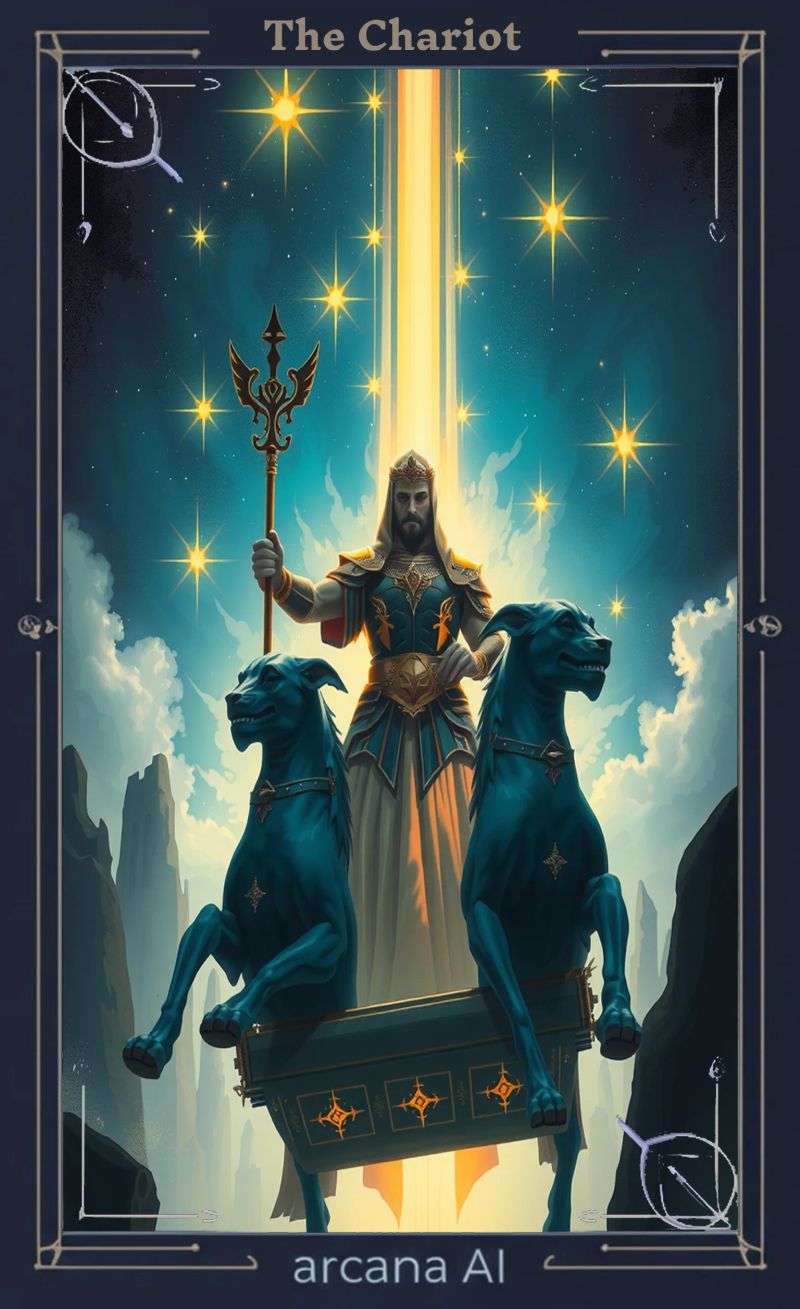
The Chariot charges forth as the supreme symbol of focused determination, disciplined willpower, emotional mastery, and hard-won victory. Numbered seven in the Major Arcana, this card marks the completion of the first septenary of the tarot, the sequence dedicated to the establishment and triumph of the personal ego. Clothed in ornate armor adorned with lunar symbols and standing beneath a canopy of celestial stars, a youthful warrior steers a stone chariot pulled by two opposing sphinxes. Holding no physical reins, he guides these contrary beasts purely through mental focus and clear intent. The Chariot proves that obstacles are overcome not by brute violence, but through unwavering purpose, emotional composure, and the conscious integration of conflicting internal impulses.
Position in the Deck
Major Arcana - Card 7. As the final card of the first line of the Major Arcana, The Chariot represents the crowning achievement of individual development. The wanderer has mastered the conscious will of The Magician, the intuition of The High Priestess, the nurture of The Empress, the discipline of The Emperor, the education of The Hierophant, and the choices of The Lovers, consolidating these forces into victorious worldly agency.
Upright Meaning
When The Chariot appears upright, it brings a surge of forward momentum, ambition, and triumphant focus. It signals that you are overcoming resistance, outmaneuvering obstacles, and driving a critical situation toward a successful conclusion. This card does not promise an easy, frictionless journey; rather, it assures you that with fierce self-discipline, emotional self-control, and unshakeable confidence, victory is within your grasp. It counsels you to maintain your focus, refuse to be sidetracked by petty distractions, and drive boldly toward your goal.
Love and Relationships
In romantic readings, The Chariot upright signifies determination to work through relationship hurdles, mutual loyalty, and moving forward as a unified team. For couples who have experienced past misunderstandings or external family pressures, this card indicates that shared focus will triumph over adversity. It often accompanies practical milestones, such as relocating to a new city together or making a joint long-term investment.
If you are single, The Chariot advises stepping into your romantic power with clear standards. Know what you desire in a partner, communicate your intentions directly, and refuse to settle for ambiguous situationships. It can also indicate meeting a motivated, ambitious suitor who travels frequently or works in high-impact professions.
Career and Finances
In career matters, The Chariot is one of the most auspicious cards in the deck. It portends promotions, executive victories, triumphant project completions, and competitive dominance in your industry. If you have been vying for a coveted client, patent, or corporate leadership role, The Chariot indicates that your disciplined preparation and tactical focus will outpace the competition.
Financially, this card represents gaining firm control over your economic affairs. You are steering your budget with discipline, eliminating lingering debts, and investing with bold, calculated precision. It confirms that financial independence is achieved through strategic persistence rather than passive hope.
Spiritual Practice and Personal Growth
Spiritually, The Chariot teaches that emotional self-containment is the true foundation of inner strength. The warrior does not suppress his wild emotions or deny his contradictory desires; instead, he harnesses them as fuel for spiritual growth. Through daily contemplative discipline, martial arts, breathwork, or focused meditation, you build an unshakeable psychological container capable of withstanding the chaotic currents of the external world.
Reversed Meaning
When The Chariot appears reversed, the focused vehicle of will loses its steering, crashing into aggressive conflict, reckless impulsiveness, or total exhaustion and defeat.
Warning Signs and Blocks
Reversed, this card warns that you are either forcing an outcome with brute aggression or have completely lost control over your circumstances. You may be bulldozing over the feelings of loved ones in an arrogant obsession with winning at all costs. Alternatively, it reflects chronic self-doubt, scattered priorities, and paralyzing indecision: pulled in opposite directions by conflicting desires, your momentum grinds to a demoralizing halt.
Love and Relationships
In relationships, The Chariot reversed points to ugly power struggles, controlling dynamics, and emotional stonewalling. One partner may dominate conversations and dictate terms, treating intimacy as a battlefield to be conquered rather than a shared sanctuary. It can also indicate a partnership drifting aimlessly without shared goals, where unresolved arguments cycle endlessly without resolution. Mutual surrender of ego is required to avert a relational crash.
Career and Finances
Professionally, the reversal warns of derailed projects, failed negotiations, and career burnout. You may have overreached, taking on responsibilities without the operational capacity to deliver. It can also point to workplace hostility, road rage, or aggressive corporate sabotage. Step back, re-evaluate your strategy, and rebuild your resources before attempting another push.
Spiritual Stagnation
Spiritually, the reversed Chariot warns against spiritual bypassing and the illusion of absolute ego control. When you believe that your personal willpower can force the cosmos to bend to your whims, life often delivers a humbling obstacle to remind you of your limits. It calls for practicing surrender, humility, and graceful receptivity.
Psychological Archetype and Shadow Dynamics
Jungian Archetype: The Hero and the Integrated Ego
In Jungian psychology, The Chariot represents the Hero Archetype and the consolidation of a strong, coherent Ego. The hero must separate from the maternal collective unconscious, prove his strength against trials in the world, and construct a stable psychic identity. The chariot itself represents the protective psychic vessel (the persona and character armor) that allows the soul to navigate hostile external environments without being dissolved by unconscious projections.
Shadow Dynamics: The Ruthless Megalomaniac and the Defeated Coward
The shadow of The Chariot unfolds in two destructive forms:
- The Ruthless Megalomaniac: Intoxicated by power and control, the individual views all human relationships as transactions and all peers as obstacles to be crushed. Empathy is discarded as weakness, leading to spiritual isolation and inevitable collapse.
- The Paralyzed Defeatist: Terrified of failure or conflict, the individual surrenders their steering wheel to others, allowing external circumstances, family demands, and fleeting impulses to toss them about like flotsam.
Integrating this shadow means understanding that true strength is quiet, self-contained, and protective, using will to serve life rather than dominate it.
Symbolic Elements
- The Armored Charioteer: The driver stands upright without sitting, wearing full plate armor adorned with lunar crescents upon his epaulets (resembling the Urim and Thummim, symbols of divine divination and discernment). This indicates that he is actively engaged, vigilant, and protected by emotional composure.
- The Canopy of Celestial Stars: Above the vehicle arches a blue canopy studded with six-pointed stars, signifying that although he operates in the material world, his quest is guided and protected by higher cosmic forces.
- The Black and White Sphinxes: Resting in front of the vehicle are two sphinxes, one black and one white, representing the fundamental polarities of existence: positive and negative, conscious and unconscious, severity and mercy. They pull in opposite directions; the charioteer must maintain equilibrium through focused consciousness alone.
- The Stone Chariot with Winged Globe: The vehicle is carved from a solid block of grey stone, merging the rider directly with his vehicle. On the front rests a winged solar disk (divine spirit) above a Hindu lingam-yoni symbol (the union of masculine and feminine creative forces).
- The Scepter of Will: In his right hand, the charioteer holds an ivory scepter topped with a golden sphere and pyramid, symbolizing the focused direction of mental authority.
- The Fortified City Left Behind: In the background, beyond the river, stand the stone towers and walls of an organized city. The hero has left the safe, conditioned confines of civilized comfort to venture into the untamed wilderness of destiny.
Historical and Esoteric Context
In the historic Renaissance decks, Card VII depicted a triumphant military procession, inspired by the Roman triumphus and Petrarch’s poetic Trionfi. The card represented earthly victory, civic honor, and the moral triumph of virtue over worldly temptation.
In the Golden Dawn esoteric system, S.L. MacGregor Mathers and A.E. Waite attributed The Chariot to the zodiac sign Cancer. This attribution provides deep esoteric nuance: Cancer is a water sign ruled by the Moon, symbolizing the crab inside its protective armor, the mother’s womb, and emotional containment. The Chariot is thus not merely a symbol of martial aggression, but the sacred enclosure that protects the vulnerable spark of spirit as it journeys across the material world.
Card Interactions
- The Magician (I): The Magician provides the raw elemental tools and conscious intention; The Chariot provides the sustained endurance and vehicle to carry that intention to ultimate worldly victory.
- The Tower (XVI): If The Chariot’s victory breeds arrogance and imperialist hubris, The Tower eventually strikes with lightning to shatter the chariot’s stone armor and humble the proud driver.
- Strength (VIII): While The Chariot masters opposing forces through focused external will and armor, Strength masters the instinctual beast through gentle internal love, compassion, and spiritual patience.
Elemental and Astrological Correspondences
- Astrological Attribution: Cancer, the Cardinal Water sign ruled by the Moon, symbolizing emotional depth, instinctual protection, home, and resilient psychic boundaries.
- Elemental Affinity: Water (underneath its martial armor, the motivation of The Chariot is deep emotional loyalty and devotion).
- Hebrew Letter: Cheth (meaning “Fence” or “Enclosure”), representing the sacred wall of protection that shelters life.
- Tree of Life Path: Path 18, connecting Binah (Understanding) to Geburah (Severity/Strength), bringing deep cosmic understanding through courageous, decisive action.
Esoteric Meanings
Esoterically, The Chariot is the Merkabah, the divine throne-chariot of Jewish mysticism described by the prophet Ezekiel. It teaches that the human personality is a vehicle constructed to transport the divine soul through physical incarnation. When you master your conflicting thoughts and desires, your life becomes a victorious vehicle of celestial purpose.
Contemplative Journaling Prompts
- What conflicting internal desires or emotions are currently pulling me in opposite directions, and how can I bring them into alignment?
- Where in my life do I need to exercise firmer self-discipline and stop letting distractions derail my progress?
- Am I driving toward my goals with calm confidence, or am I bulldozing others with aggressive impatience?
- What safe, familiar comfort zone do I need to leave behind in order to claim my true destiny?
Frequently Asked Questions about The Chariot
What does The Chariot mean in a love reading?
Upright, The Chariot signifies overcoming obstacles together, mutual loyalty, and taking proactive steps to move the relationship forward (such as moving in, traveling, or resolving past disputes). Reversed, it warns of ugly power struggles, controlling behavior, emotional stonewalling, or drifting without shared direction.
Is The Chariot a ‘yes’ or ‘no’ card?
The Chariot is an enthusiastic YES, especially for questions involving ambitious goals, travel, career advancement, and overcoming competitive challenges. Success is assured if you stay focused, disciplined, and proactive.
Why does the charioteer have no reins to steer the sphinxes?
The absence of physical reins illustrates that true mastery is mental and spiritual rather than physical. The charioteer directs the opposing black and white sphinxes through sheer mental clarity, unwavering intent, and emotional containment.
What is the difference between The Chariot and The Magician?
The Magician initiates: he gathers the elemental tools and sparks the initial intention (“as above, so below”). The Chariot executes and completes: he takes that intention out into the challenging arena of the world, navigating real-world resistance until decisive victory is achieved.