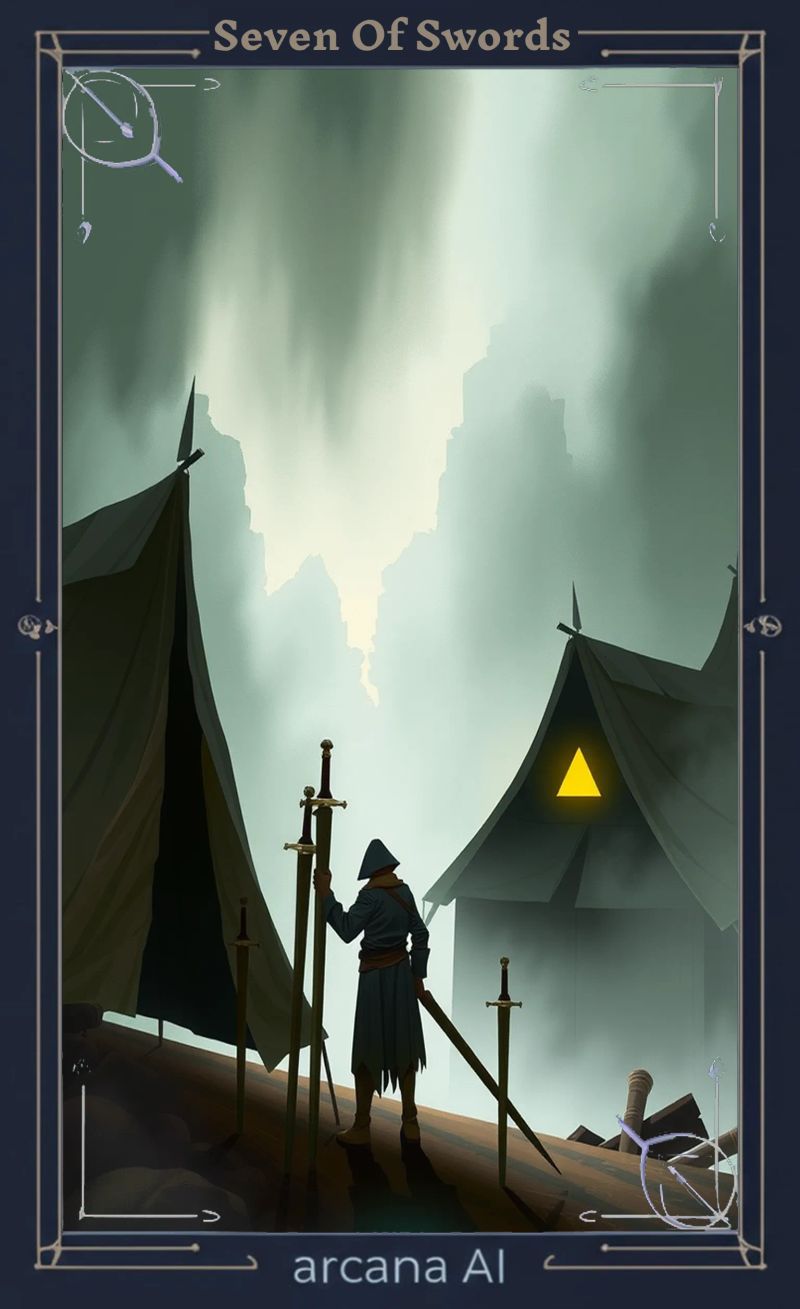
The Seven of Swords slips into the tarot as the enigmatic emblem of strategic cunning, mental agility, stealthy maneuvers, tactical discretion, and the dangerous temptation of deception. Following the peaceful communal ferry ride of the Six of Swords, the number seven introduces the solitary rogue: an individual operating outside the consensus of the group. Under a brilliant yellow sky, a lithe figure wearing a red cap and boots tiptoes away from a military encampment of colorful pavilions. In his arms he clutches five steel swords by their sharp blades, casting a sly, confident smile over his shoulder back at the camp. Behind him, two upright swords remain planted firmly in the ground. The Seven of Swords is a complex psychological mirror: at its highest vibration, it represents clever tactical strategy, working autonomously, and outsmarting adversaries without violence; at its lower vibration, it exposes betrayal, cheating, fraud, sneaking around, and the corrosive fear of being exposed.
Position in the Deck
Minor Arcana - Suit of Swords, Card 7. In the suit of air and mental acuity, the Seven represents tactical intelligence: using unconventional methods, discretion, and strategic maneuvering to solve problems when direct frontal confrontation is impossible or disadvantageous.
Upright Meaning
When the Seven of Swords appears upright, it signals that straightforward, direct approaches will not succeed in your current situation. You must employ tactical discretion, mental agility, and strategic planning. Keep your plans confidential, protect your intellectual property, and observe the landscape with keen discernment before making your move. However, this card also serves as a potent warning against dishonesty: examine your own motives and those of people around you. Someone may be withholding vital information, operating with hidden agendas, or attempting to take credit for your achievements. It advises you to verify facts independently and avoid revealing your entire strategy to rivals.
Love and Relationships
In relationship readings, the Seven of Swords upright is a serious caution flag regarding emotional dishonesty, secrets, and lack of transparency. A partner may be concealing financial problems, maintaining secretive online friendships, or engaging in emotional or physical infidelity. It can also indicate that you are avoiding difficult conversations, sneaking around to pursue private interests because you fear your partner’s anger or judgment.
If you are single, this card warns against suitors who present a polished, charming persona that hides inconsistent facts. Look past smooth words and verify whether their lifestyle matches their claims. In your own dating approach, avoid playing manipulative psychological games: genuine intimacy cannot be built on deception.
Career and Finances
In professional environments, the Seven of Swords highlights stealth mode startups, proprietary research, strategic pivots, and competitive intelligence. If you are developing an innovative product, writing a manuscript, or planning a career move, the card advises keeping your project confidential until you have secured patents, trademarks, or signed contracts. Beware of colleagues who eavesdrop on meetings or attempt to steal your ideas.
Financially, this card represents protecting your assets against fraud, phishing scams, and predatory contracts. Review credit card statements meticulously, safeguard passwords, and avoid shady investment proposals that operate in regulatory gray areas. It warns against cutting tax corners or bending financial laws: covert shortcuts eventually lead to public exposure.
Spiritual Practice and Personal Growth
Spiritually, the Seven of Swords represents the archetype of the Lone Wolf and the holy fool’s cunning. There are times when spiritual seekers must quietly slip away from dogmatic religious groups or unsupportive family circles to pursue their own truth. It invites you to develop discernment: you do not owe everyone an explanation of your spiritual beliefs. Silence and discretion protect the fragile seed of inner awakening.
Reversed Meaning
When the Seven of Swords appears reversed, the veil of secrecy tears open, exposing deceit, forcing confessions, and clearing the path for honest accountability and redemption.
Warning Signs and Blocks
Reversed, this card frequently signals that a covert scheme has been discovered. The truth is coming out, lies are unraveling, and those who engaged in deception must face the music. Alternatively, it represents the breakthrough of conscience: an individual can no longer tolerate the internal agony of living a double life, stepping forward voluntarily to confess their mistakes, make restitution, and seek forgiveness.
Love and Relationships
In romance, the Seven of Swords reversed marks the moment of revelation. Secret affairs, hidden bank accounts, or long-standing deceptions are brought to light, forcing partners into a crisis of truth. While devastating, this exposure dissolves the toxic fog of suspicion. Couples who choose to rebuild must undergo rigorous counseling and total transparency. For singles, it signals breaking free from a deceitful partner and learning to trust your intuition when warning flags appear.
Career and Finances
Professionally, the reversal indicates the exposure of workplace fraud, embezzlement, or intellectual property theft. Audits uncover accounting discrepancies, and whistleblowers come forward with documentation. For an individual, it warns that attempting to cut corners or falsify credentials will inevitably result in professional humiliation and legal consequences. Embrace absolute transparency and ethical integrity.
Spiritual Stagnation
Spiritually, the Seven of Swords reversed points to conquering imposter syndrome. You may have been plagued by feelings of being an intellectual fraud, secretly fearing that colleagues will discover you lack qualifications. The card reminds you that your talents are genuine; lay down the heavy burden of pretense and stand confidently in your authentic gifts.
Psychological Archetype and Shadow Dynamics
Jungian Archetype: The Trickster and the Cunning Rogue
In Jungian psychology, the Seven of Swords embodies the Trickster Archetype (Hermes, Loki, Coyote) and the psychological mechanism of Rationalization. The Trickster uses wit, humor, and unorthodox cunning to dismantle rigid social rules, exposing the hypocrisy of the established order. However, when unintegrated, the Trickster becomes a compulsive liar, fabricating excuses and convincing the conscious ego that bending the truth is completely justified.
Shadow Dynamics: The Pathological Manipulator and the Paralyzed Imposter
The shadow of the Seven of Swords splits into two destructive behavioral traps:
- The Machiavellian Con Artist: Addicted to outsmarting others, the individual treats all human relationships as a game of chess, taking pride in their ability to manipulate friends and colleagues without getting caught, until they find themselves completely isolated and friendless.
- The Chronic Imposter: Paralyzed by the terror of being exposed as inadequate, the individual lives in constant anxiety, hiding their true thoughts, feelings, and creative work behind a safe, bland mask of conformity.
Integration occurs when cunning intellect is placed in service of ethical truth: using mental agility to solve complex problems, protect the vulnerable, and speak with tactical diplomacy.
Symbolic Elements
- The Man Tiptoeing Away: Clothed in a red cap and boots with a green tunic, the figure walks on tiptoe, looking back over his shoulder toward the encampment. His posture reflects alertness, guilt, and the stealthy retreat of someone executing an unauthorized maneuver.
- The Five Swords Held by the Blades: In his arms he clutches five steel swords, remarkably holding them barehanded by their sharp edges without cutting himself. This illustrates immense mental agility, precision, and the perilous nature of his enterprise: one slip, and his own weapons will wound him.
- The Two Swords Left Behind: Two swords remain planted vertically in the earth behind him. This detail symbolizes that he could not carry everything: every stealthy shortcut leaves behind evidence, loose ends, or unfinished business.
- The Military Encampment: Colorful pavilions and tents stand in the background, representing the established collective army, social structure, and rules from which the rogue has defected.
- The Distant Armed Soldiers: In the far distance to the left, tiny figures of armed guards stand, with one raising a spear. This indicates that the camp is stirring and the alarm is about to sound; time is running out for the rogue.
- The Bright Yellow Sky: The radiant golden background symbolizes high intellect, conscious mental calculation, and the illumination of awareness that will eventually bring all secret deeds to light.
Historical and Esoteric Context
In the historic Tarot de Marseille, the Seven of Swords featured seven curved swords interwoven around a central vertical blade, representing complex mental strategy and intellectual containment.
In the Hermetic Order of the Golden Dawn, the card was titled “The Lord of Unstable Effort” and assigned to the third decan of Aquarius, ruled by the Moon. This astrological combination is deeply revealing: the fluctuating, nocturnal, subconscious, and secretive nature of the Moon is placed within eccentric, inventive, and detached Aquarius, under the sphere of Netzach (desire and victory). The result is brilliant tactical intellect coupled with emotional instability and erratic follow-through: attempts to achieve goals through clever shortcuts rather than disciplined, sustained effort. Pamela Colman Smith synthesized this into the classic image of the sword-thief, creating an enduring masterpiece of psychological duplicity and tactical strategy.
Card Interactions
- The Magician (I): The Magician commands the tools openly on his table with transparent conscious mastery; the Seven of Swords steals the tools in secret to gain an unfair advantage.
- The Hierophant (V): The Hierophant represents institutional dogma, public orthodoxy, and strict moral conformity; the Seven of Swords represents the solitary defector who flouts collective rules to pursue an unorthodox agenda.
- Justice (XI): The Seven of Swords attempts to evade accountability; Justice swings the sword of objective truth and balances the scales, ensuring that all hidden actions face their natural consequences.
Elemental and Astrological Correspondences
- Astrological Attribution: Moon in Aquarius (Third Decan of Aquarius, 20° to 30° Aquarius), uniting subconscious cunning, unconventional tactics, and intellectual detachment.
- Elemental Affinity: Air (mental, strategic, tactical, and communicative).
- Kabbalistic Sephirah: Netzach in Yetzirah (Victory and Emotional Drive in the World of Formation), the effort to achieve desire through mental agility and unorthodox strategy.
- Esoteric Title: The Lord of Unstable Effort.
Esoteric Meanings
Esoterically, the Seven of Swords reveals that you can never truly deceive the cosmos. You may fool colleagues, partners, and society for a season, but the subconscious mind records every dishonest act, creating internal guilt and psychic fractures that undermine your peace. True mastery does not require stealth or deceit; when your actions are rooted in cosmic truth, you walk in broad daylight without looking over your shoulder.
Contemplative Journaling Prompts
- Where in my life am I tempted to take a dishonest shortcut rather than doing the disciplined, patient work?
- Is there a difficult truth I am avoiding expressing to a partner or colleague, and how can I communicate it with diplomatic honesty?
- In what areas of my creative or professional life do I need to exercise greater tactical discretion and keep my plans confidential?
- What imposter fears am I ready to release so that I can stand authentically in my true capability?
Frequently Asked Questions about the Seven of Swords
Does the Seven of Swords always mean cheating or infidelity?
While the Seven of Swords frequently warns of deception, secrets, or infidelity in relationship readings, it does not always mean an affair. It often points to emotional withholding, secret spending, avoiding necessary conflict, or feeling that a partner is not being entirely upfront about their thoughts and feelings.
Is the Seven of Swords a ‘yes’ or ‘no’ card?
The Seven of Swords is generally a cautious NO. It indicates that the current path involves deception, hidden obstacles, or unsustainable shortcuts. If you must proceed, it advises using extreme strategic discretion and verifying every detail independently.
Why did the figure leave two swords behind?
Leaving two swords behind shows that shortcuts and deceptive maneuvers are inherently incomplete. You cannot carry the whole prize through stealth; you will inevitably leave behind evidence, unfinished business, or loose ends that eventually reveal your actions.
Can the Seven of Swords ever be a positive card?
Yes. In competitive business, strategic planning, or leaving toxic environments, it represents mental agility, working quietly in stealth mode, protecting intellectual property, and outsmarting bullies without resorting to physical violence. It reminds us that wisdom sometimes requires strategic silence.