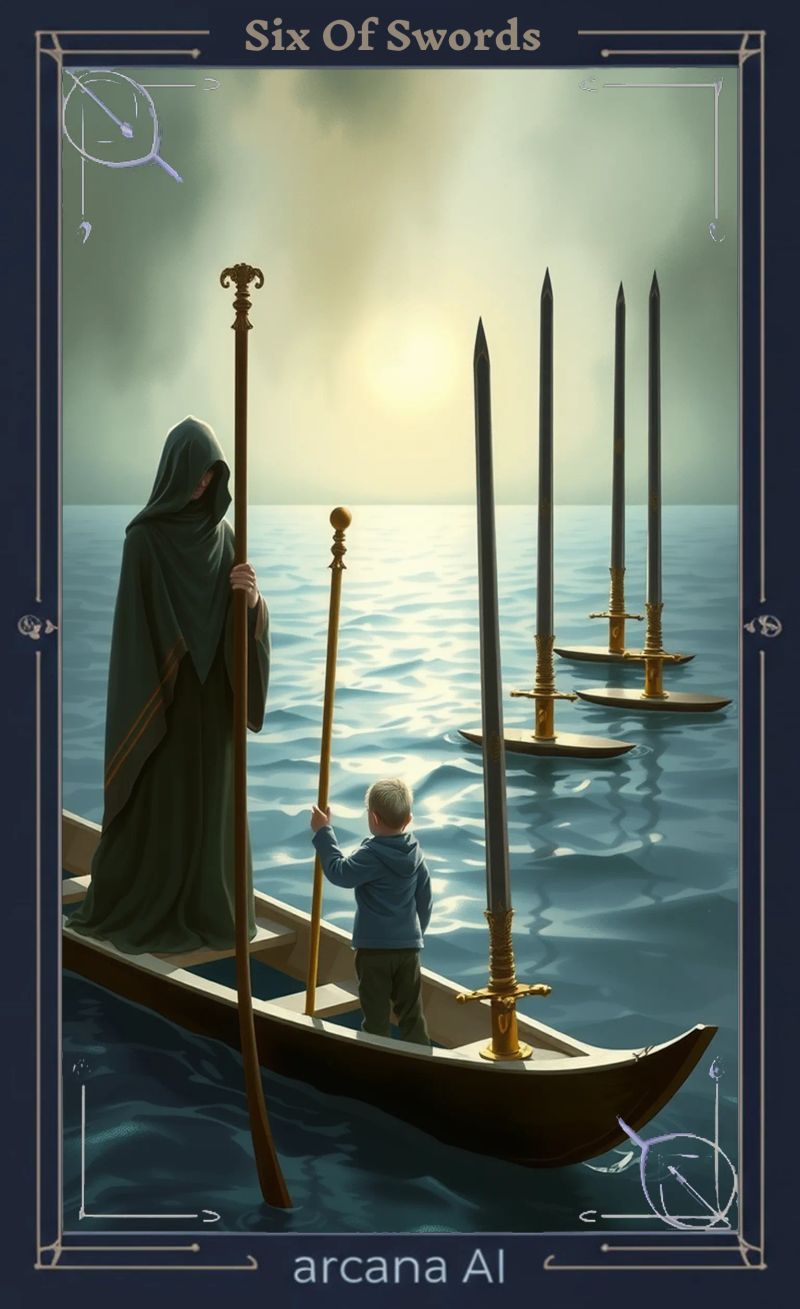
The Six of Swords glides across the waters of the tarot as the solemn, hopeful symbol of transition, mental passage, quiet recovery, and the journey from turbulent adversity toward peaceful shores. Following the bitter battleground of the Five of Swords, the number six restores equilibrium, mental clarity, and purposeful navigation. In Pamela Colman Smith’s evocative scene, a ferryman stands in a wooden punt, steering his vessel across a body of water with a long wooden pole. Huddled before him are a woman draped in an all-enveloping cloak and a small child, their heads bowed in quiet mourning or exhaustion. Six upright swords are embedded directly into the floor of the boat, standing between the passengers and the ferryman. Notably, the water on the right side of the boat is choppy and disturbed, while the water ahead on the left is smooth as glass, leading toward a tranquil, verdant shore. The Six of Swords reminds you that while leaving a painful chapter behind is solemn and bittersweet, moving toward peace is the only way to heal the soul.
Position in the Deck
Minor Arcana - Suit of Swords, Card 6. In the suit of air and intellect, the Six represents the restorative journey of the mind: the conscious decision to disengage from destructive conflicts, cross the waters of grief, and navigate toward emotional sanctuary.
Upright Meaning
When the Six of Swords appears upright, it brings a gentle, steady promise of relief, transition, and gradual healing. The worst of the storm is behind you. While you may still carry the emotional fatigue, grief, and memories of past trials (represented by the swords in the boat), you are actively moving toward calmer, safer circumstances. This card frequently indicates physical relocation, moving to a new home, taking a restorative trip, changing jobs, or simply achieving mental peace after prolonged anxiety. It counsels you to keep moving forward, trust your guide or internal compass, and allow time and distance to work their healing medicine.
Love and Relationships
In romance, the Six of Swords upright signals moving past relationship turbulence toward stability, mutual calm, and emotional recovery. For couples who have endured serious crises, arguments, or outside stresses, this card indicates that you are entering a peaceful harbor. Partners agree to leave old resentments behind, establishing a quieter, more supportive domestic routine.
If a relationship has proven irrevocably unhealthy, the Six of Swords represents the dignified, courageous decision to walk away. It is not an angry, slammed-door departure, but a solemn, quiet packing of bags and stepping onto the ferry. For singles, it indicates that you are finally ready to leave past heartbreak behind, navigating toward emotional readiness for genuine, peaceful partnership.
Career and Finances
Professionally, the Six of Swords points to leaving toxic work environments, transferring to a supportive team, or relocating for career advancement. If you have survived corporate restructuring, layoffs, or stressful project deadlines, a much calmer and more organized work pace is emerging. It is an auspicious omen for career counseling, continuing education, and consulting roles where your past hardships translate into valuable expertise.
Financially, this card indicates moving from financial chaos toward fiscal stability. Debts are being systematically paid off, financial disputes are resolving, and cash flow is steadying. It encourages cautious, disciplined financial management as you rebuild your economic reserves.
Spiritual Practice and Personal Growth
Spiritually, the Six of Swords represents the passage across the river of the subconscious: the transition from ego fragmentation into integrated peace. In contemplative practice, it invites you into quiet retreats, silent meditation, and digital detoxes. By stepping away from the noisy chatter of the world, your mind naturally calms down, reflecting the clear sky of pure awareness.
Reversed Meaning
When the Six of Swords appears reversed, the necessary transition becomes stalled, disrupted, or actively resisted, leaving you trapped in turbulent waters with unresolved baggage.
Warning Signs and Blocks
Reversed, this card warns of travel delays, postponed relocations, or feeling mentally stuck in the past. You may be physically in a new location, yet mentally replaying old conflicts on an endless loop. Alternatively, it reflects running away from problems without addressing root causes: moving across the country or switching partners while bringing your unexamined neuroses along, only to recreate the exact same drama in a new setting.
Love and Relationships
In love, the Six of Swords reversed points to lingering attachments to toxic exes, checking an old flame’s social media, or returning repeatedly to an emotionally destructive dynamic. In struggling relationships, it indicates that partners cannot move forward because past betrayals are constantly dredged up in arguments. True healing requires either committing fully to forgiveness or completing the departure without vacillation.
Career and Finances
In career inquiries, the reversal warns of cancelled corporate transfers, botched onboarding processes, or discovering that a new employer is just as dysfunctional as the one you left. It can also point to resisting necessary organizational modernization out of fear of learning new technologies. Financially, it cautions against unexpected moving expenses or unresolved debts following you to your new residence.
Spiritual Stagnation
Spiritually, the Six of Swords reversed indicates resistance to the natural cycles of growth and closure. You may be desperately trying to revive obsolete spiritual identities or clinging to a community that has become toxic. The card reminds you that the river flows in one direction; surrender your resistance and allow yourself to be carried into the new chapter.
Psychological Archetype and Shadow Dynamics
Jungian Archetype: The Ferryman and the Rite of Passage
In Jungian psychology, the Six of Swords corresponds to the archetype of the Psychopomp / Ferryman (Charon crossing the River Styx) and the universal structure of the Rite of Passage: separation, liminal transition, and reincorporation. The cloaked passengers represent the vulnerable, wounded ego undergoing the liminal crossing between old obsolete identities and the new, emerging Self. The swords in the boat represent conscious memories: we do not erase past trauma, but carry it with us as distilled wisdom to protect our future.
Shadow Dynamics: The Chronic Escapist and the Anxious Anchor
The shadow of the Six of Swords manifests across two dysfunctional behaviors:
- The Geographic Escapist: Addicted to running away, the individual moves from city to city, relationship to relationship, believing that physical distance will magically cure their internal unhappiness, forever fleeing the inner shadow.
- The Anxious Clinger: Terrified of the unknown, the individual clings desperately to sinking ships, preferring familiar misery over the quiet uncertainty of the crossing.
Integration involves understanding that true peace is an internal state cultivated through acceptance, allowing oneself to grieve what was lost while stepping boldly onto the ferry of the future.
Symbolic Elements
- The Ferryman with the Pole: Standing tall at the stern of the boat, the ferryman uses a wooden pole to propel the craft across the shallows. He symbolizes guidance, practical wisdom, conscious navigation, and the steady discipline required to steer life through difficult transitions.
- The Cloaked Mother and Child: Huddled in the bow, wrapped in dark blankets, they represent vulnerability, exhaustion, grief, and the precious spark of new life that must be protected during crisis. Their faces are hidden, emphasizing internal withdrawal and solemn introspection.
- The Six Upright Swords: Standing planted in the hull of the vessel, the swords form a protective screen between the passengers and the steersman. They represent the memories, lessons, and emotional wounds of past battles that are carried forward, yet contained so they do not sink the craft.
- The Choppy Water vs. Smooth Water: Notice the water: directly beside the boat on the right are ripples and choppy waves, representing the turbulent past just departed. Ahead on the left, the water is calm, glass-like, and serene, representing the peace awaiting the travelers.
- The Green Shoreline: In the distance rises a verdant, tree-lined bank under a pale sky, symbolizing safety, fertility, physical rest, and a welcoming new home.
Historical and Esoteric Context
In the historic Tarot de Marseille, the Six of Swords featured six curved blades arranged symmetrically around a central floral bud, symbolizing mental balance and the containment of intellectual force.
In the Hermetic Order of the Golden Dawn, the card was titled “The Lord of Earned Success” and assigned to the second decan of Aquarius, ruled by Mercury. This attribution unites the innovative, objective intellect of Aquarius with the communicative agility and analytical navigation of Mercury, placed within the beauty and harmony of Tiphareth. The result is the triumph of rational intellect over emotional chaos: the mind finds practical, elegant solutions to extract the soul from danger and guide it into safe harbor. A.E. Waite and Pamela Colman Smith drew upon the ancient myth of Charon to transform this abstract Sephirah into one of the most emotionally resonant images in the entire tarot.
Card Interactions
- Five of Swords: The Five represents the catastrophic, toxic battlefield; the Six represents the quiet departure of the survivors onto the rescue boat.
- Death (XIII): Death represents the total metaphysical ending of a cycle; the Six of Swords represents the practical, day-to-day transition and travel required to live out that ending in physical reality.
- Eight of Cups: Both cards signify walking away from unfulfilling situations. The Eight of Cups walks away into the mountains out of emotional dissatisfaction; the Six of Swords travels by water to escape dangerous conflict and find emotional safety.
Elemental and Astrological Correspondences
- Astrological Attribution: Mercury in Aquarius (Second Decan of Aquarius, 10° to 20° Aquarius), bringing analytical problem-solving, objective vision, and intellectual navigation to difficult life passages.
- Elemental Affinity: Air / Water synthesis (the analytical intellect of Air guiding the emotional waters of Water).
- Kabbalistic Sephirah: Tiphareth in Yetzirah (Beauty and Harmony in the World of Formation), the restoration of solar peace and mental equilibrium after hardship.
- Esoteric Title: The Lord of Earned Success.
Esoteric Meanings
Esoterically, the Six of Swords teaches that the spiritual path is an ongoing migration. You are a pilgrim on the earth, never meant to build permanent stone fortresses in temporary valleys of sorrow. When you have learned the lessons of a trial, pack your wisdom, step into the boat of consciousness, and let grace ferry you to the next shore of your evolution.
Contemplative Journaling Prompts
- What past conflict, habit, or toxic environment am I currently ready to leave behind for good?
- What emotional baggage or old resentment am I carrying in my boat that is weighing down my journey?
- How can I be more gentle, patient, and compassionate with myself while navigating this delicate transition?
- What does my ideal peaceful harbor look like, and what practical steps can I take today to steer toward it?
Frequently Asked Questions about the Six of Swords
What does the Six of Swords mean in a love reading?
Upright, the Six of Swords indicates moving past relationship conflict into a phase of quiet recovery, mutual support, and emotional calm. If an unhealthy relationship has ended, it signifies the courageous decision to walk away and heal. Reversed, it warns of being unable to let go of an ex, bringing past relationship baggage into a new romance, or returning to toxic dynamics.
Is the Six of Swords a ‘yes’ or ‘no’ card?
The Six of Swords is a gentle, definitive YES. It confirms that you will successfully navigate out of difficulty, reach calmer waters, and find relief, provided you are willing to let go of the past and accept the journey.
Why are the swords stuck inside the boat?
The swords represent past wounds, memories, and lessons. They are carried inside the boat because we cannot magically erase past experiences; however, because they stand upright without piercing the hull, they do not sink the craft. They serve as a protective barrier and a reminder of hard-won wisdom.
Does the Six of Swords always indicate physical travel?
While it frequently indicates physical travel, vacations, or moving to a new home, it equally signifies a psychological and emotional transition: changing your mindset, disengaging from anxiety, and finding quiet mental clarity after turmoil.