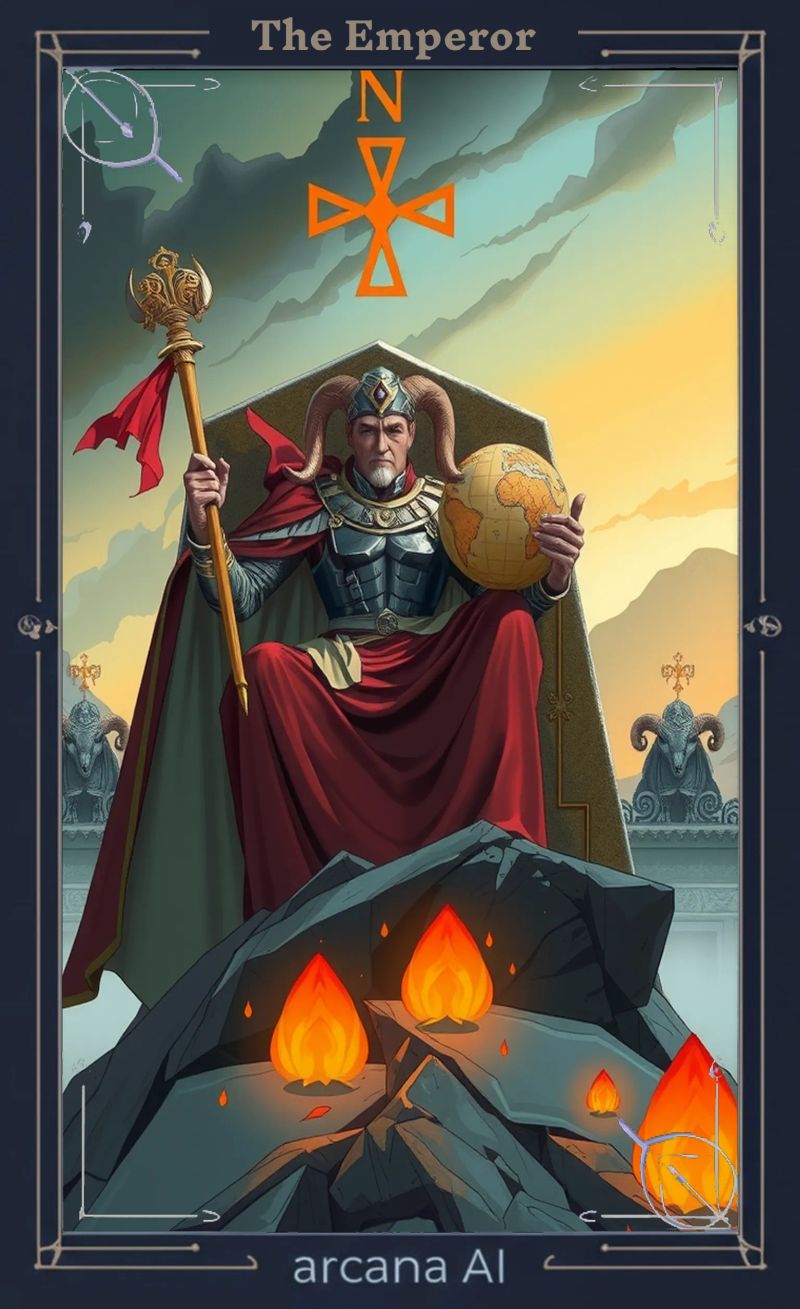
The Emperor sits upon a formidable cubic throne of stone, embodying sovereign authority, structural stability, rational order, and protective power. Numbered four in the Major Arcana, he represents the architect of civilization, the benevolent father archetype, and the conscious mind establishing clear laws amidst the chaotic forces of existence. While The Empress cultivates the wild, organic growth of the garden, The Emperor builds the stone walls, aqueducts, and legal codes that defend that garden and ensure its bounty endures across generations. Clothed in martial armor beneath crimson imperial robes, he reminds you that authentic freedom is not lawless chaos, but the fruit of self-discipline, boundaries, and principled responsibility.
Position in the Deck
Major Arcana - Card 4. Followed by the creative fertility of The Empress, The Emperor provides the solid bedrock, structural framework, and worldly governance needed to anchor creative vision into enduring institutional form.
Upright Meaning
When The Emperor appears upright, he calls for leadership, strategic organization, firm boundaries, and rational discipline. This is a moment to step into your sovereign authority, make tough executive decisions, and bring structured order to chaotic circumstances. You are urged to master your emotions with reason, formulate a concrete action plan, and execute it with calm persistence. The card assures you that establishing solid routines, clear boundaries, and professional standards will lead to lasting stability and hard-won victory.
Love and Relationships
In romantic readings, The Emperor upright signifies reliability, emotional safety, enduring commitment, and clear expectations. If you are in an established relationship, this card indicates that your partnership is built upon mutual respect, shared practical goals, and unshakeable fidelity. Partners support one another through life’s storms, taking pride in providing a secure, comfortable home.
If you are single, The Emperor suggests looking for a mature, grounded partner who values accountability, consistency, and long-term commitment. It warns against chasing emotionally volatile drama, advising you instead to welcome someone whose actions match their promises. In your own dating approach, uphold your personal standards with calm dignity and communicate your expectations clearly from the outset.
Career and Finances
In career matters, The Emperor is a powerhouse of executive success. It indicates promotions, leadership appointments, successful project management, and the establishment of scalable corporate or entrepreneurial systems. You are positioned to lead teams, establish operational protocols, and mentor junior colleagues. The card advises you to approach challenges with methodical strategy, decisive logic, and unyielding professionalism.
Financially, this card represents fiscal conservatism, prudent budgeting, and building long-term wealth through tangible assets and sound investments. Avoid speculative get-rich-quick ventures. Instead, establish clear financial budgets, consult experienced advisors, pay down liabilities, and construct an economic fortress that guarantees security for your future.
Spiritual Practice and Personal Growth
Spiritually, The Emperor teaches that discipline is the essential bridge to genuine freedom. Casual intentions and sporadic meditation do not build enduring spiritual muscle. Establishing a dedicated morning routine, mastering your physical impulses through ascetic focus, and aligning your moral code with your daily actions anchors spiritual wisdom into your bodily existence. He challenges you to be the sovereign monarch of your own mind.
Reversed Meaning
When The Emperor appears reversed, authority curdles into tyrannical domination, rigid dogmatism, childish stubbornness, or a catastrophic failure of discipline and accountability.
Warning Signs and Blocks
Reversed, this card frequently points to abusive authority figures, micromanaging bosses, or domineering partners who rule through intimidation and emotional coldness. Alternatively, it represents total administrative breakdown: chronic disorganization, lack of discipline, avoidance of adult responsibility, or paralysis caused by the fear of making difficult decisions. It warns that rigid stubbornness will cause structures to shatter under real-world pressure.
Love and Relationships
In relationships, The Emperor reversed exposes controlling dynamics, jealousy, emotional unavailability, and patriarchal dominance. A partner may insist on having their way at all times, treating the relationship as a monarchy where their word is absolute law. It can also point to financial control, where money is used as an instrument of coercion. Conversely, it can signify a partner who refuses to mature, acting like an entitled child who refuses to contribute equally to domestic and emotional labor.
Career and Finances
Professionally, the reversal warns of workplace tyranny, oppressive bureaucracy, and toxic management cultures that punish innovation. Projects may fail due to inflexible planning that refuses to adapt to shifting market conditions. For an individual, it warns that arrogance, poor temper control, or cutting legal corners will lead to a humiliating fall from power. Strict adherence to ethics and transparent communication is necessary to avert disaster.
Spiritual Stagnation
Spiritually, The Emperor reversed indicates rigid religious fundamentalism, dogmatic moralizing, or using intellectual rules to suppress natural human emotions. By mistaking rigid doctrine for spiritual depth, the soul becomes arid and joyless. It calls for softening the hard edges of your ego, practicing humility, and reconnecting with compassion.
Psychological Archetype and Shadow Dynamics
Jungian Archetype: The Father and the Logos
In Jungian psychology, The Emperor personifies the Father Archetype and the principle of Logos (objective reason, structural discrimination, law, and consciousness). He represents the psychological capacity to differentiate oneself from the unconscious maternal matrix, establish distinct boundaries, and operate effectively within the social contract. The Emperor is the internal psychic ruler that transforms chaotic impulses into structured, productive civilization.
Shadow Dynamics: The Tyrant and the Weakling
The shadow of The Emperor oscillates between two destructive polarities:
- The Inflexible Tyrant: Terrified of chaos, vulnerability, and mortality, the individual builds an iron cage around themselves and others. Every difference of opinion is perceived as treason, and control is maintained through fear, emotional cruelty, and relentless surveillance.
- The Abdicating Weakling: Paralyzed by the weight of authority and the fear of failure, the individual abdicates all responsibility. They become passive, blaming systems and external forces for their plight, unable to protect their own boundaries or establish basic order in their lives.
Integrating this shadow involves understanding that true sovereign authority does not require brute force; it is grounded in service, fairness, calm emotional containment, and the courage to protect what is vulnerable.
Symbolic Elements
- The Stone Cubic Throne: Unlike the soft cushions of The Empress, The Emperor sits upon an unyielding block of grey granite. The cube symbolizes the number four, material reality, geometric perfection, and unshakeable physical foundations.
- The Four Ram Heads: Carved into the corners of the throne and resting upon his armor are four ram heads, the symbol of Aries and its ruling planet Mars. This denotes fiery initiative, pioneering courage, martial determination, and executive leadership.
- The Crimson Robes and Steel Armor: Beneath his royal scarlet robe, The Emperor wears full plate armor, with iron greaves visible at his feet. This signifies that he remains continuously prepared to defend his kingdom and defend his principles against sudden assault.
- The Ankh Scepter and Golden Orb: In his right hand, he holds an Egyptian Ankh (the Crux Ansata, symbol of life and divine sovereignty), while in his left hand he balances a golden orb representing worldly dominion. This affirms that his temporal authority is legitimate only when it serves to protect and sustain life.
- The Barren Mountain Range: Behind his throne rises a jagged, red-hued mountain range stripped of all vegetation. The stark landscape represents emotional austerity, stoic endurance, and the hard heights of rational clarity where sentimentality cannot cloud judgment.
- The Narrow River at the Mountain Base: A tiny blue ribbon of water trickles at the base of the mountains, indicating that even in the most austere landscape of duty and logic, the emotional flow of life continues to sustain human hope.
Historical and Esoteric Context
In the historical tarot of the fifteenth and sixteenth centuries, The Emperor depicted the Holy Roman Emperor, holding an imperial orb and scepter, often accompanied by the black double-headed eagle. He stood alongside the Pope as the twin pillar of medieval Christian societal order.
In the esoteric system developed by the Hermetic Order of the Golden Dawn, The Emperor was assigned to the zodiac sign Aries, the first sign of the zodiac. This brilliant attribution elevated him from a tired medieval monarch into the cosmic archetype of pioneering masculine force, structural law, and the initial spark of mental order that organizes raw chaos into a structured cosmos.
Card Interactions
- The Empress (III): Together, they represent the divine parents of the tarot. The Empress provides organic abundance and unconditional love; The Emperor provides structure, safety, and legal order. Harmony exists when both are honored equally.
- The Hierophant (V): The Emperor rules secular, civic, and material law (the throne); The Hierophant rules sacred, moral, and spiritual doctrine (the altar).
- The Tower (XVI): When The Emperor becomes an inflexible tyrant building corrupt, rigid institutions, The Tower eventually strikes with lightning to shatter the stone walls and restore humility to the soul.
Elemental and Astrological Correspondences
- Astrological Attribution: Aries, the pioneering Cardinal Fire sign ruled by Mars, symbolizing assertive leadership, ambition, courage, and executive will.
- Elemental Affinity: Fire (purifying, assertive, dynamic, and protective).
- Hebrew Letter: Heh (meaning “Window” or “Sight”), representing clear vision, constitutional order, and the ability to survey one’s domain with objective discernment.
- Tree of Life Path: Path 15, connecting Chokmah (Dynamic Wisdom) to Tiphareth (Solar Harmony), channeling cosmic creative impulse into structured harmony within the human heart.
Esoteric Meanings
Esoterically, The Emperor teaches that external stability is a direct mirror of internal sovereignty. You cannot build a peaceful external life upon an internal foundation of chaotic impulses and undisciplined thoughts. By establishing mastery over your passions, honoring your commitments, and defending what is sacred with dignified courage, you claim your rightful place as the sovereign monarch of your own destiny.
Contemplative Journaling Prompts
- Where in my life am I allowing chaos and lack of discipline to erode my peace of mind?
- Am I exercising authority with calm fairness, or have I become rigid, stubborn, and defensive?
- What healthy boundaries do I need to establish and uphold with colleagues, friends, or romantic partners?
- How can I lead by personal example today rather than demanding respect from others?
Frequently Asked Questions about The Emperor
What does The Emperor mean in a love reading?
Upright, The Emperor represents enduring loyalty, protective care, stability, and emotional dependability. It signals a mature partner who follows through on commitments and builds a secure home. Reversed, it warns of controlling, domineering behavior, emotional coldness, jealousy, or an immature partner who refuses to take adult responsibility.
Is The Emperor a ‘yes’ or ‘no’ card?
The Emperor is a clear YES, particularly for questions regarding career advancement, legal matters, business organization, and practical affairs. However, it requires you to be disciplined, organized, and accountable rather than leaving things to chance.
What is the relationship between The Emperor and The Empress?
The Emperor and The Empress represent the twin foundations of life: structure and nature, discipline and pleasure, law and love. Without The Empress, The Emperor becomes an arid, cruel tyrant; without The Emperor, the garden of The Empress is vulnerable to external predators. In a mature psyche, both work in seamless partnership.
Why does The Emperor wear armor under his robes?
The armor signifies that sovereign leadership carries constant vigilance and defensive duty. It is not enough to declare ideals; a true leader must have the moral courage, emotional fortitude, and practical strength to protect their boundaries and community against real-world adversity.