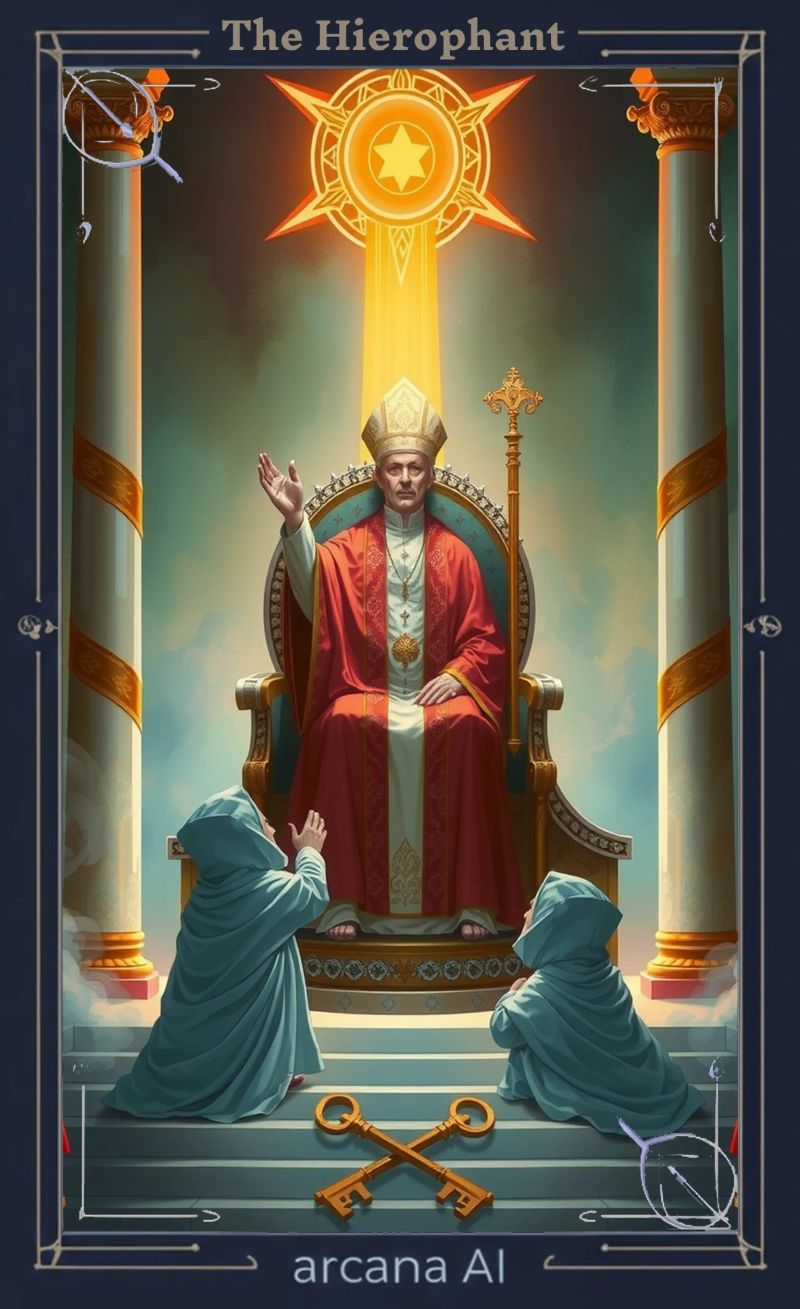
The Hierophant sits enthroned between the sacred pillars of spiritual tradition, acting as the bridge between humanity and the divine mysteries. Numbered five in the Major Arcana, he is the master teacher, the keeper of sacred doctrine, the spiritual mentor, and the guardian of collective wisdom. While The Emperor builds the legal and material structures of the secular state, The Hierophant establishes the moral foundations, ritual initiations, and ethical frameworks that unite human souls into enduring communities of shared faith and purpose. Clothed in liturgical robes and raising his right hand in blessing, he calls you to honor time-tested wisdom, seek ethical guidance, and ground personal exploration in collective integrity.
Position in the Deck
Major Arcana - Card 5. Following the four cornerstones of The Emperor’s material order, The Hierophant introduces the fifth element: quintessence, spiritual conscience, and the structured transmission of sacred knowledge from generation to generation.
Upright Meaning
When The Hierophant appears upright, he highlights the value of structured learning, established lineages, ethical accountability, and traditional rites of passage. This is an invitation to seek mentorship from experienced teachers, align yourself with trusted communities, or deepen your mastery within an established field of study. Rather than reinventing the wheel through reckless trial and error, you are encouraged to study the classical foundations, absorb the hard-earned lessons of predecessors, and honor proven methodology.
Love and Relationships
In romance, The Hierophant is one of the classic cards of formal commitment, shared ethical values, and traditional marriage. For established couples, it signifies deepening devotion rooted in mutual spiritual principles, family approval, and institutional recognition. It encourages couples to navigate relationship milestones with formal agreements, open vows, and shared cultural or spiritual practices that build a lasting home.
If you are single, The Hierophant suggests seeking partners who share your fundamental life philosophy, spiritual values, and long-term intentions. It counsels against ephemeral flings with emotionally mismatched companions. Look for relationships within communities of common interest, where ethical accountability and honest expectations are established from the first meeting.
Career and Finances
In career readings, The Hierophant points toward success within structured organizations, universities, healthcare systems, legal institutions, and established corporations. It highlights the importance of teamwork, professional credentialing, adhering to workplace codes of conduct, and seeking guidance from seasoned supervisors. This is a favorable card for completing certifications, passing formal examinations, and contributing to institutional excellence.
Financially, this card advises traditional money management and fiscal conservatism. Invest in established index funds, trusted real estate, or accredited retirement plans. Avoid unconventional financial fads or speculative schemes. Seeking counsel from an accredited financial planner will safeguard your long-term prosperity.
Spiritual Practice and Personal Growth
Spiritually, The Hierophant counsels grounding your inner search within an established lineage or contemplative tradition. While solitary intuition is valuable, engaging with classical philosophical systems, traditional rituals, or group meditation provides structural safety and depth. The card reminds you that tradition is not a dusty prison, but a living taproot connecting you to millennia of collective human insight.
Reversed Meaning
When The Hierophant appears reversed, sacred tradition curdles into dogmatic fundamentalism, hypocritical moralizing, empty bureaucracy, or oppressive social conformity.
Warning Signs and Blocks
Reversed, this card warns against blind obedience to corrupt institutions or authoritarian gurus who demand total surrender of your critical intellect. It exposes dogmatic gatekeeping, where ancient wisdom is withheld or weaponized to maintain social control. Alternatively, it signifies that an outdated rule, familial expectation, or religious dogma has become an intolerable cage that suffocates your authentic moral conscience.
Love and Relationships
In love, The Hierophant reversed often points to ideological warfare, clashes over religious beliefs, or pressure from family traditions that reject your partnership. It can also signify an unconventional relationship that defies cultural norms, such as intercultural bonds or non-traditional domestic arrangements. The card counsels you to prioritize authentic mutual devotion over superficial social approval.
Career and Finances
Professionally, the reversal indicates toxic workplace orthodoxy, micromanagement by obsolete leadership, and corporate cultures that punish innovative thinking. You may feel compelled to challenge bureaucratic red tape or expose unethical institutional practices. For entrepreneurs, it signals breaking away from corporate rigidity to pioneer novel business models.
Spiritual Stagnation
Spiritually, The Hierophant reversed warns against spiritual materialism, religious guilt, or outsourcing your moral conscience to an external authority. When spiritual leaders preach purity while practicing abuse, the soul must reclaim its direct, sovereign connection to the divine. The card urges you to examine inherited beliefs and discard those rooted in fear rather than love.
Psychological Archetype and Shadow Dynamics
Jungian Archetype: The Senex and the Spiritual Father
In Jungian psychology, The Hierophant corresponds to the archetype of the Senex (The Wise Old Man) and the collective consciousness of the community. He represents the internalized superego and the structural scaffolding through which archetypal symbols are rendered intelligible to the human psyche. Without the stabilizing framework of the Hierophant, the individual ego risks drowning in the raw, uncontained imagery of the unconscious.
Shadow Dynamics: The Dogmatic Inquisitor and the Spiritual Narcissist
The shadow of The Hierophant manifests in two destructive extremes:
- The Inquisitorial Dogmatist: Terrified of uncertainty, the individual clings to letter-of-the-law fundamentalism. Anyone who questions the established canon is condemned as a heretic, and moral cruelty is justified in the name of spiritual purity.
- The Spiritual Narcissist: Claiming exclusive divine revelation, a charismatic leader sets themselves above the law, manipulating vulnerable seekers under the guise of enlightenment.
Healthy integration occurs when tradition is approached as a living guide rather than an unchangeable idol, allowing timeless wisdom to evolve in response to genuine human need.
Symbolic Elements
- The Triple Papal Tiara: The towering crown worn by The Hierophant features three distinct tiers, symbolizing spiritual authority across the three realms: the physical world, the subconscious mind, and the celestial sphere.
- The Triple Papal Cross: Held in his left hand, the cross with three horizontal bars represents dominion over the Trinity, mastery of the three spiritual planes, and the transmission of divine grace.
- The Hand Raised in Esoteric Blessing: His right hand is raised with two fingers pointing upward and two folded inward, the traditional gesture of benediction and the esoteric sign of esotericism: revealing what is public while guarding what is occult.
- The Two Crossed Keys: Resting at his feet upon the red carpet are the crossed keys of Saint Peter, one gold (representing the solar mysteries and conscious understanding) and one silver (representing the lunar mysteries and subconscious receptivity). They unlock the gates of heaven and earth.
- The Two Kneeling Priests: Before the altar kneel two initiates. One wears robes patterned with red roses (symbolizing the active path of worldly devotion and passion); the other wears robes patterned with white lilies (symbolizing the contemplative path of intellectual purification).
- The Twin Stone Pillars: Flanking his throne are two grey stone columns, representing the gateway of the sanctuary. Unlike the black and white pillars of The High Priestess, these columns are identical in color, emphasizing social equality and doctrinal unity within the assembly.
Historical and Esoteric Context
In the historic Renaissance decks, Card V was known as Il Papa (The Pope), directly portraying the Roman Catholic pontiff as the supreme moral authority of Christendom. Alongside The Emperor, The Pope represented the spiritual pole of medieval social order.
During the eighteenth-century occult revival, French occultist Antoine Court de Gébelin renamed the card Le Hiérophante, drawing upon the ancient Greek title for the chief priest of the Eleusinian Mysteries who revealed sacred relics to initiated candidates. In the 1909 Rider-Waite-Smith deck, A.E. Waite retained the ecclesiastical regalia while deepening its Kabbalistic and Hermetic symbolism as the universal teacher of esoteric truth.
Card Interactions
- The Emperor (IV): The Emperor governs secular civil order and temporal law; The Hierophant governs spiritual morality, ritual initiation, and metaphysical doctrine.
- The High Priestess (II): The High Priestess preserves private, unspoken, intuitive mysticism within the inner sanctuary; The Hierophant formulates, codifies, and teaches that mysticism publicly through community liturgy and sacred study.
- The Lovers (VI): The Hierophant provides the moral and ethical framework for sacred union; The Lovers must then exercise personal moral autonomy and make the conscious, heartfelt choice to unite.
Elemental and Astrological Correspondences
- Astrological Attribution: Taurus, the fixed Earth sign ruled by Venus, symbolizing steadfast loyalty, enduring tradition, physical patience, and solid material foundations.
- Elemental Affinity: Earth (stable, grounding, historical, and institutional).
- Hebrew Letter: Vav (meaning “Nail” or “Peg”), the connective letter of the Hebrew alphabet that binds words and concepts together, just as The Hierophant binds human souls to divine grace.
- Tree of Life Path: Path 16, connecting Chokmah (Wisdom) to Chesed (Mercy), channeling divine inspiration into structured, compassionate teaching.
Esoteric Meanings
Esoterically, The Hierophant teaches that true initiation is an internal metamorphosis that requires external discipline. The forms, rituals, and teachings of a spiritual tradition are sacred vessels designed to hold divine grace without spilling it into emotional chaos. When approached with humility and discernment, classical wisdom accelerates individual spiritual evolution.
Contemplative Journaling Prompts
- What traditional belief, habit, or cultural expectation am I upholding purely out of social guilt rather than authentic conviction?
- Who in my life embodies mature, ethical mentorship, and how can I learn from their lived experience?
- How can I integrate more sacred ritual and structured discipline into my daily spiritual practice?
- Where am I being called to lead with moral integrity and set an example for my peers?
Frequently Asked Questions about The Hierophant
What does The Hierophant mean in a love reading?
Upright, The Hierophant indicates strong relationship commitment, traditional marriage, shared moral values, and social support. It points to partnerships built on loyalty, mutual respect, and long-term planning. Reversed, it warns of unconventional relationship dynamics, ideological differences, family interference, or chafing against restrictive expectations.
Is The Hierophant a ‘yes’ or ‘no’ card?
The Hierophant is generally a cautious YES, specifically when the situation aligns with established ethical standards, formal agreements, and honest practices. It advises against shortcuts, deception, or breaking established agreements.
What do the crossed keys at The Hierophant’s feet mean?
The golden key represents solar consciousness and active understanding; the silver key represents lunar intuition and receptive subconscious wisdom. Together, they signify that the full mysteries of life are unlocked when analytical discipline and intuitive reverence work in harmony.
What is the difference between The Hierophant and The High Priestess?
The High Priestess represents personal, solitary intuition and unspoken spiritual mysteries experienced in quiet contemplation. The Hierophant represents collective, communal wisdom and codified doctrine taught publicly within an organized tradition. The Priestess invites you to listen within; The Hierophant invites you to learn within community.