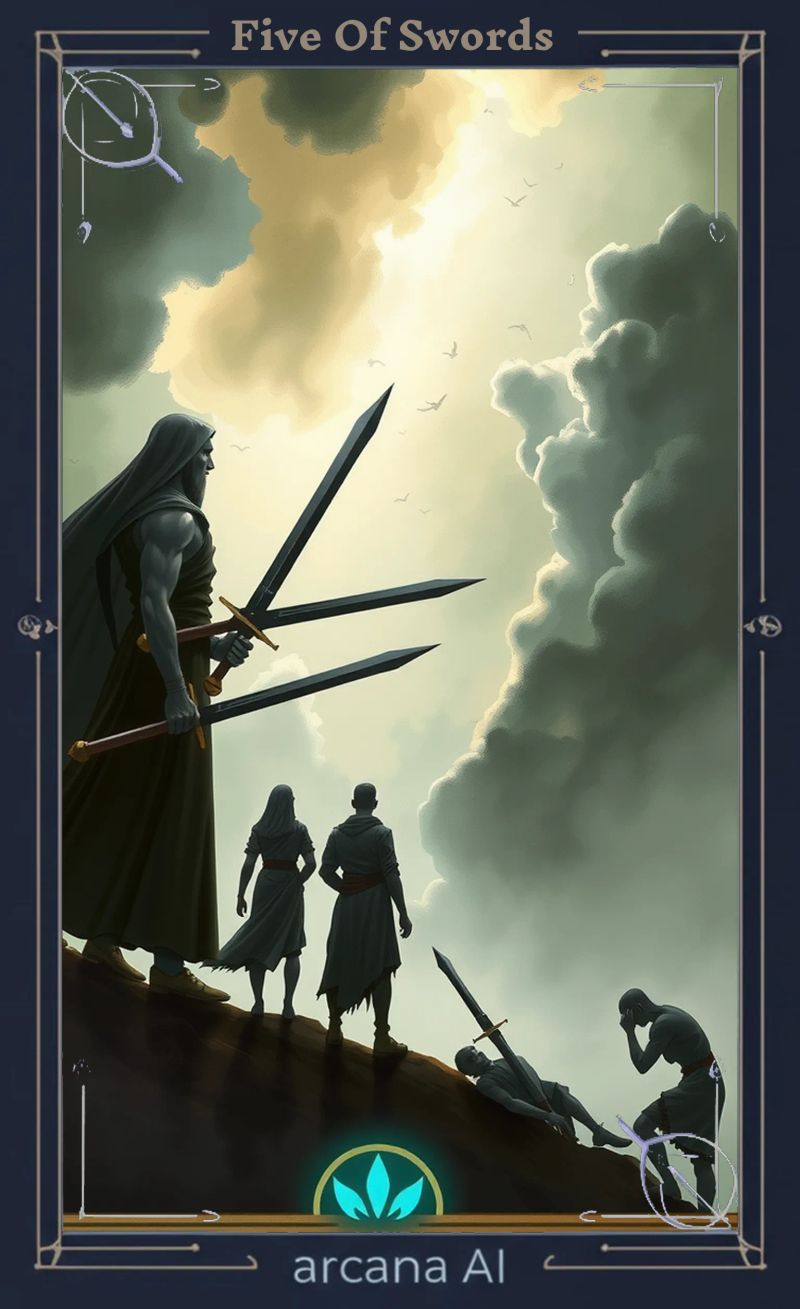
The Five of Swords cuts through the tarot as the supreme archetype of hollow victory, bitter conflict, cutthroat egoism, and the devastating realization that winning an argument can cost you everything that truly matters. Following the tranquil meditative sanctuary of the Four of Swords, the number five shatters stability with disruptive discord, ideological combat, and ethical compromise. On a windswept coastline beneath jagged, turbulent clouds, a sly figure smirks over his shoulder as he gathers three discarded swords, while two defeated adversaries walk away in dejection, their shoulders slumped in humiliation. The Five of Swords represents a classic Pyrrhic victory: you may have demolished your opponent with ruthless intellect or deceitful tactics, but in doing so, you have incinerated trust, destroyed community, and isolated your own soul.
Position in the Deck
Minor Arcana - Suit of Swords, Card 5. In the suit of air and intellect, the Five represents the ethical crisis of the mind: the destructive misuse of intelligence, verbal cruelty, and the hollow emptiness that follows winning at all costs.
Upright Meaning
When the Five of Swords appears upright, it serves as a stern warning against engaging in toxic conflicts, ruthless ambition, or petty arguments where victory brings no real satisfaction. You may be dealing with someone in your personal or professional life who plays dirty, uses intimidation, or revels in humiliating others. Alternatively, it challenges your own behavior: have you prioritized being right over being loving? Have you weaponized facts to crush a loved one’s spirit? The card advises you to choose your battles with profound care, step away from unwinnable ideological disputes, and remember that some victories are far more damaging than graceful surrender.
Love and Relationships
In romance, the Five of Swords upright is a serious warning sign of toxic communication, verbal abuse, scorekeeping, and contempt. Arguments are no longer about resolving issues or deepening intimacy; they have devolved into vicious contests to see who can inflict the deepest emotional wound. One partner may dominate conversations, mock the other’s vulnerabilities, and demand absolute submission.
If you are experiencing this dynamic, the card advises you to establish firm boundaries or walk away entirely. Staying in a relationship where intimacy has become a hostile warzone destroys self-worth. For singles, it warns against dating charismatic suitors who boast about outsmarting their exes or displaying a manipulative lack of empathy.
Career and Finances
Professionally, the Five of Swords highlights cutthroat workplace politics, corporate sabotage, intellectual property theft, and hostile work environments. A colleague or supervisor may take credit for your labor, undermine your reputation through whispered rumors, or use unethical tactics to win promotions. The card cautions against stooping to their level: winning a mud-slinging contest merely leaves you covered in filth. Protect your documentation, consult legal advisors, and prepare an orderly exit strategy if the corporate culture is irredeemably toxic.
Financially, this card indicates disputes over inheritance, bitter contract negotiations, or financial losses caused by deceitful partners. It warns against aggressive lawsuits driven purely by spite, where legal fees ultimately swallow any material gain. Settle disputes fairly and cut your losses.
Spiritual Practice and Personal Growth
Spiritually, the Five of Swords exposes the dark side of the spiritual ego. It points to intellectual superiority, spiritual elitism, and using philosophical concepts to invalidate the feelings of others. Preaching dogma while lacking basic compassion is a profound spiritual failure. The card invites you to practice radical humility, apologize for past verbal cruelty, and recognize that true wisdom listens far more than it argues.
Reversed Meaning
When the Five of Swords appears reversed, the toxic battlefield begins to quiet down. It heralds a desire to lay down your weapons, seek genuine reconciliation, or finally walk away from an abusive conflict that cannot be repaired.
Warning Signs and Blocks
Reversed, this card can signify two distinct trajectories. On one hand, it indicates healthy fatigue with conflict: both parties realize the futility of fighting and agree to a ceasefire, seeking mediation and honest dialogue. On the other hand, it can expose lingering resentment, grudge-holding, and covert revenge tactics. Unspoken hostility can smolder beneath the surface, waiting for an opportunity to strike back.
Love and Relationships
In relationships, the Five of Swords reversed marks a pivotal turning point. Couples who have engaged in bitter fighting may experience a breakthrough of humility: laying down ego defenses, apologizing sincerely for cruel words, and committing to compassionate communication therapy. If the relationship is toxic beyond repair, the reversal gives you the courage to pack your bags and leave without looking back, refusing to engage in one final retaliatory screaming match.
Career and Finances
Professionally, the reversal signals the resolution of contentious workplace disputes, settling lawsuits out of court, or toxic management being removed by executive leadership. Team members acknowledge collective mistakes and begin rebuilding trust. For an individual, it represents walking away from an ethically compromised company to preserve your personal integrity.
Spiritual Stagnation
Spiritually, the Five of Swords reversed warns against chronic self-recrimination. You may be constantly beating yourself up over past mistakes, replaying old arguments in your mind, and declaring yourself unredeemable. The card calls for forgiving your own past immaturity, making restitution where possible, and letting the past rest.
Psychological Archetype and Shadow Dynamics
Jungian Archetype: The Shadow Intellect and the Narcissistic Ego
In Jungian psychology, the Five of Swords represents the Shadow of the Thinking Function and the pathology of the Narcissistic Ego. When thinking is completely severed from feeling and empathy, it becomes cold, predatory, and cruel. The ego views all relationships as zero-sum dominance hierarchies where one must either conquer or be conquered. The two figures walking away represent the alienated, rejected parts of the psyche: when the ego ruthlessly suppresses its own vulnerability, it is left victorious but fundamentally isolated.
Shadow Dynamics: The Sadistic Bully and the Spiteful Loser
The shadow of the Five of Swords manifests across two complementary polarities:
- The Sadistic Dominator: Driven by unacknowledged weakness, the individual compensates by dominating others intellectually and emotionally, delighting in seeing colleagues and partners squirm under their superior rhetoric.
- The Spiteful Saboteur: Convinced that the world has cheated them, the defeated individual plots covert revenge, using passive-aggressive sabotage, anonymous complaints, and character assassination to drag winners down to their level.
Integration requires realizing that authentic human worth cannot be established by defeating others. True strength lies in collaborative service, emotional safety, and moral integrity.
Symbolic Elements
- The Smirking Victor: In the foreground, a man with a mocking smile gathers swords. He holds two across his shoulder and points a third into the turf, embodying arrogant triumph and the illusion of absolute control.
- The Two Defeated Figures: In the middle distance, two men turn their backs and walk away toward the shoreline. One hangs his head while the other weeps into his hands, symbolizing the genuine emotional suffering, alienation, and loss of dignity left in the wake of cutthroat conflict.
- The Discarded Swords on the Ground: Two swords lie abandoned upon the grass, indicating that the battle is over, weapons have been surrendered, and the cost of the confrontation was devastatingly high.
- The Jagged, Torn Clouds: Overhead, jagged storm clouds blow in chaotic, serrated patterns across the sky, reflecting the mental hostility, turbulence, and fractured thoughts of the combatants.
- The Choppy Grey Sea: In the background, waves churn with whitecaps, symbolizing the agitated, resentful emotional currents that linger long after the verbal arguments have ceased.
Historical and Esoteric Context
In the historic Tarot de Marseille, the Five of Swords depicted four curved swords arranged in an oval around a central straight blade, representing sharp geometric tension and mental division.
In the Hermetic Order of the Golden Dawn, the card was titled “The Lord of Defeat” and assigned to the first decan of Aquarius, ruled by Venus. This attribution presents a fascinating esoteric paradox: Venus, the planet of love and harmony, is placed within intellectual, eccentric Aquarius, and governed by Geburah (the Sephirah of severe judgment and force). The result is the corruption of relational harmony: intellect is weaponized against love, producing bitter estrangement. Pamela Colman Smith captured this dark dilemma brilliantly, depicting the gloating victor standing alone on a desolate coast.
Card Interactions
- Four of Swords: The Four represents peaceful sanctuary, rest, and contemplative neutrality; the Five shatters that peace with aggressive conflict and competitive hostility.
- Six of Swords: The Six represents the ferry journey away from the devastation of the Five, carrying the wounded survivors away from the battlefield toward tranquil waters.
- Justice (XI): While the Five of Swords represents selfish victory achieved through unfairness and deceit, Justice restores objective truth, fairness, and karmic equilibrium.
Elemental and Astrological Correspondences
- Astrological Attribution: Venus in Aquarius (First Decan of Aquarius, 0° to 10° Aquarius), where social idealism and relational desires are corrupted by cold intellectual detachment and harsh competition.
- Elemental Affinity: Air (intellectual, analytical, rhetorical, and strategic).
- Kabbalistic Sephirah: Geburah in Yetzirah (Severity and Force in the World of Formation), the breaking of mental peace through conflict and division.
- Esoteric Title: The Lord of Defeat.
Esoteric Meanings
Esoterically, the Five of Swords reveals the ultimate futility of the ego’s quest for domination. The universe is a unified web of consciousness; what you do to another, you do directly to yourself. When you defeat an adversary through cruelty or deceit, your apparent worldly gain is an absolute spiritual loss. To embody wisdom is to lay down your sword and seek peace above pride.
Contemplative Journaling Prompts
- Am I holding onto an argument purely to satisfy my ego’s desire to be right, and what would happen if I chose peace instead?
- Where in my life have I achieved a victory that left me feeling hollow, regretful, or isolated?
- How can I disengage from toxic, argumentative people without stooping to their manipulative level?
- What apologies do I need to make for times I used sharp, sarcastic words to wound someone I love?
Frequently Asked Questions about the Five of Swords
What does the Five of Swords mean in a love reading?
Upright, the Five of Swords indicates toxic arguments, verbal cruelty, winning arguments at the expense of love, and feeling bullied or manipulated in a relationship. It counsels evaluating whether the bond is emotionally safe. Reversed, it signifies putting down defenses, apologizing sincerely, seeking reconciliation, or finally leaving an abusive dynamic.
Is the Five of Swords a ‘yes’ or ‘no’ card?
The Five of Swords is a strong NO. It indicates that pursuing your current objective will lead to conflict, resentment, hidden costs, or a hollow victory that alienates valuable allies.
Which character on the card represents the querent?
That depends on the reading context. If you have been feeling betrayed, marginalized, or defeated, you may be one of the figures walking away in sorrow. If you have been aggressively pursuing your ambition without regard for others, the smirking figure cautions you against the hollow cost of your victory.
What is a Pyrrhic victory in the context of this card?
A Pyrrhic victory is a win achieved at such a devastating cost that it is tantamount to defeat. In the Five of Swords, you may win the argument or claim the title, but you destroy the relationship, trust, and community in the process.