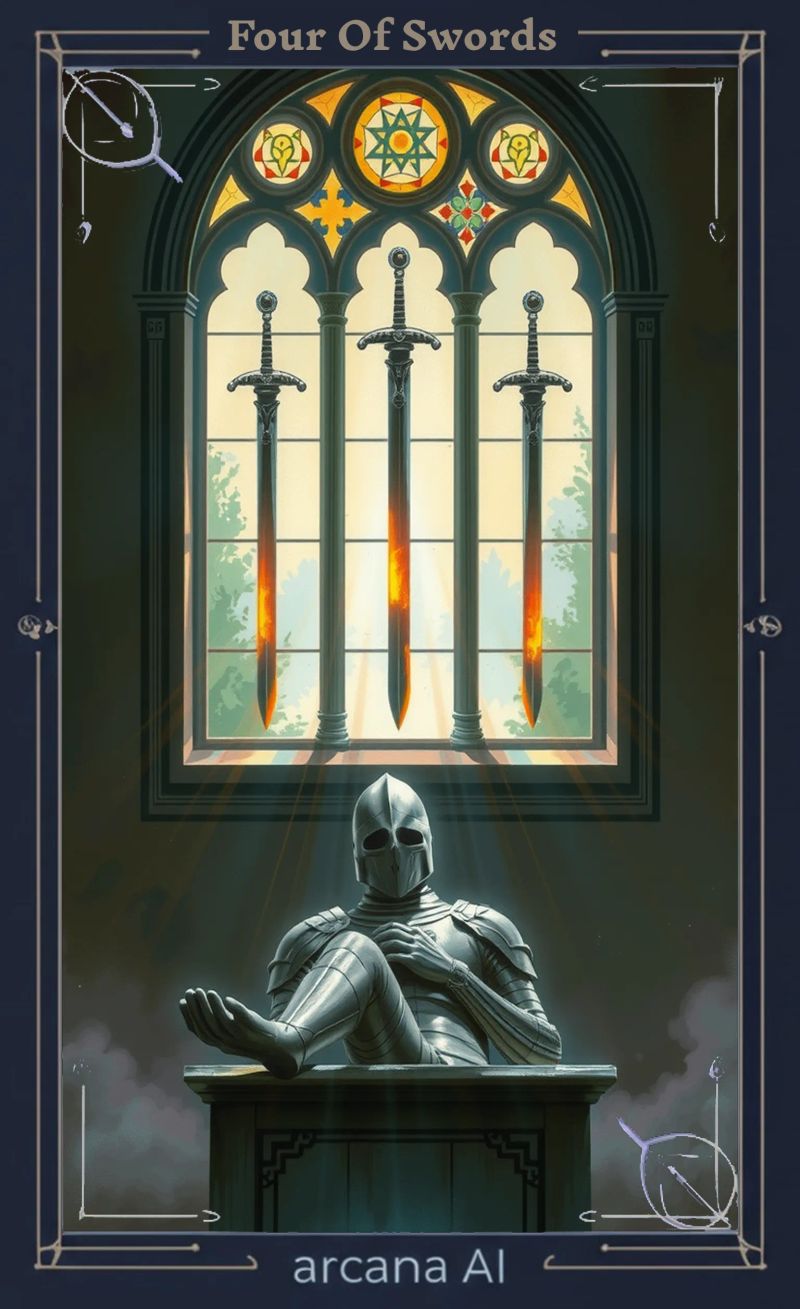
The Four of Swords represents strategic retreat, mental convalescence, contemplative sanctuary, and the restorative power of intentional silence. Emerging directly from the piercing heartbreak and psychological grief of the Three of Swords, this card marks the crucial phase where the wounded mind lays down its weapons. In a tranquil Gothic cathedral sanctuary, a knightly effigy lies peacefully atop a stone tomb with hands clasped in prayer. Three swords hang suspended above, while a fourth lies carved beneath the bier. This card teaches that rest is not a luxury or a surrender: it is a biological, emotional, and spiritual imperative required for sanity and enduring strength.
Position in the Deck
Minor Arcana - Swords Suit - Card 4 of the suit of Air. The number four imposes order, solid boundaries, and stabilizing structure upon the chaotic, hyperactive currents of the mind. In Swords, this structure manifests as a mental sanctuary, deliberate withdrawal, and peaceful restoration after battle.
Upright Meaning
In an upright position, the Four of Swords signifies mental recuperation, strategic pauses, meditative stillness, hospitality of silence, and convalescence. It indicates that you have recently endured severe cognitive stress, emotional upheaval, or prolonged intellectual combat. The universe calls for an immediate cessation of hostilities. Step back from the arena, refuse to engage in reactionary debates, and allow your nervous system to reset in quiet contemplation before planning your next move.
Practical Applications:
- Schedule dedicated digital detox days, silencing notifications and stepping away from news feeds
- Take a formal sabbatical, mental health leave, or quiet solitary weekend retreat
- Postpone signing agreements or making major life changes until your mind feels calm and rested
- Adopt daily meditation, breathwork, or restorative sleep routines to heal cognitive fatigue
- Create an emotional boundary between your professional obligations and your private recovery space
Love and Relationships (Upright)
In relationship readings, the Four of Swords advises taking a temporary time-out from tense arguments. When discussions become cyclic, exhausting, and emotionally charged, continuing to talk only inflicts further damage. Taking a few days of respectful space allows adrenaline to recede and rational perspective to return. For couples recovering from recent grief or infidelity, it signifies entering a gentle healing phase where rest and quiet presence take precedence over demands for immediate answers. For singles, it advises a hiatus from dating apps to rebuild self-worth and emotional independence.
Career and Finances (Upright)
Professionally, this card counsels against rushing into new initiatives immediately after delivering an exhausting project. Take accrued vacation time, recharge creative batteries, and let your subconscious mind process recent lessons. If you face a hostile corporate battle or office politics, your wisest strategy is non-engagement: maintain a low profile, conserve energy, and let adversaries exhaust themselves. Financially, it recommends freezing non-essential spending and pausing major investments until market volatility settles.
Reversed Meaning
When reversed, the Four of Swords carries two distinct messages depending on your current circumstances: re-entering the world after restorative rest, or severe burnout, chronic insomnia, and forced collapse. In its positive guise, it signals that your convalescence is complete: mental fog has cleared, physical stamina has returned, and you are ready to take up your sword and re-engage with life. In its shadow guise, it warns that you have pushed your body and mind past their breaking points, ignoring fatigue until illness, exhaustion, or panic forces you into bed.
Challenges and Warnings:
- Pay attention to warning signals of chronic fatigue, migraines, and insomnia before a breakdown occurs
- Do not use rest as an excuse for indefinite avoidance or agoraphobic withdrawal from life
- Re-enter busy schedules gradually rather than jumping straight back into toxic overwork
- Beware of returning to stressful environments before your emotional wounds have truly scarred over
- Accept medical, psychological, or familial support when your body demands assistance
Love and Relationships (Reversed)
In romantic contexts, the reversed Four of Swords can indicate that a period of silence between partners has served its purpose and it is time to resume honest, constructive communication. Conversely, it can signal chronic emotional withdrawal where one partner uses silence as a passive-aggressive weapon to punish the other, freezing intimacy indefinitely. For singles, it suggests ending an extended romantic hiatus and feeling ready to open your heart to connection once again.
Career and Finances (Reversed)
In the workplace, the reversed card warns of acute burnout, nervous exhaustion, and cognitive fatigue leading to critical errors on the job. It demands that you take immediate sick leave or resign from untenable working conditions. Alternatively, it marks the end of a dormant period: a stalled project restarts, job searches regain traction, and professional isolation gives way to active networking. Financially, it signals the resumption of financial obligations after a period of financial paralysis or medical expenses.
Psychological Archetype and Shadow Dynamics
In Carl Gustav Jung’s analytical psychology, the Four of Swords personifies the Archetype of the Sacred Sanctuary and the ancient practice of Incubatio (temple sleep for psychological and physical healing).
The knight lying upon the sarcophagus represents the conscious ego relinquishing control and entering a temporary death-like state of passivity. During this stillness, the unconscious mind integrates traumatic experiences (the three pierced hearts of the Three of Swords) and reorganizes mental schemas.
In shadow work, the Four of Swords uncovers two widespread modern neuroses:
- Productivity Guilt (The Workaholic Shadow): The cultural compulsion that equates stillness with laziness or moral failure. The individual feels terrified of empty time because silence forces them to confront repressed feelings of inadequacy, grief, or existential emptiness.
- Depressive Agoraphobia: The shadow of retreat where the sanctuary becomes a tomb. The individual uses rest, introversion, or depression as a shield to permanently escape the messy demands, risks, and responsibilities of adult participation in society.
Integrating the shadow of the Four of Swords requires honoring rest as a sacred discipline: recognizing that the sword of the mind must be periodically resheathed and oiled in quietness to maintain its sharpness for righteous service.
Symbolic Elements
The Knightly Effigy upon the Tomb (Gisant): A sculpted stone knight in full armor lies recumbent upon an altar-tomb with hands held in prayer. This evokes the medieval funerary monuments of crusaders, symbolizing chivalric dedication surrendered to divine peace.
The Stained Glass Window Depicting Christ and PAX: Above the knight’s head, an illuminated church window depicts Christ blessing a kneeling disciple, accompanied by the Latin word PAX (Peace). It signifies that healing takes place under spiritual grace and divine protection.
The Three Swords Hanging from the Wall: Three swords point downward above the knight’s head and chest, representing past conflicts, anxieties, and intellectual challenges that are temporarily suspended and disarmed.
The Fourth Sword Carved on the Side of the Tomb: A single horizontal sword lies engraved beneath the figure, showing that the knight has not abandoned his intellect: he has grounded it within stone stability, ready to be wielded when his strength returns.
Color Symbolism:
- Stone Gray and Ochre: Durability, solemnity, neutral calm, and grounded endurance
- Ruby Red and Amber (stained glass): Latent spiritual vitality preserved within stillness
- Cobalt Blue (window details): Higher wisdom, serenity, and mental clarity through contemplation
- Gold Accents (halo and hilt): Spiritual sovereignty and the priceless value of inner peace
Historical and Esoteric Context
The iconography of the Four of Swords is among the most historically rich in the Rider-Waite-Smith deck:
- The Tomb of Winchelsea Church: Pamela Colman Smith drew direct architectural inspiration from the 14th-century knight’s effigy at St. Thomas the Martyr Church in Winchelsea, Sussex, which she sketched during travels with the Lyceum Theatre troupe.
- Jupiter in Libra (The Astrological Decan): In the Hermetic Order of the Golden Dawn, this card is titled the “Lord of Rest from Strife.” It corresponds to the third decan of Libra, ruled by Jupiter. The benevolent, expansive wisdom of Jupiter brings harmonious balance and peaceful resolution to the analytical, judicial nature of Libra.
- The Kabbalistic Chesed of Yetzirah: Represents the fourth Sephirah (Chesed, Mercy and Grace) in the formative world of Air (Yetzirah). Chesed calms the tempest of mental conflict, providing a merciful harbor of peace.
Card Interactions
With The Hermit: Deepens solitary contemplation into a transformative spiritual quest, favoring long-term meditation, philosophical writing, or silent retreats. With The Three of Swords: Forms a direct narrative arc: the grief and heartbreak suffered in the Three finds its necessary balm, rest, and convalescence in the Four. With The Eight of Swords: Contrasts voluntary, healing retreat (Four of Swords) with victimized, self-imposed mental imprisonment (Eight of Swords). With The Knight of Swords: Warns against reckless, aggressive charges into battle, urging the consultant to adopt the stillness of the Four before acting. With The World: Confirms that a period of necessary isolation successfully culminates in complete wholeness, renewal, and reintegration into society.
Elemental and Astrological Correspondences
Element: Air (mental stillness, calm intellect, breathwork, clear consciousness) Astrological Decan: Third Decan of Libra (20° to 30° Libra) Planetary Ruler of Decan: Jupiter in Libra Kabbalistic Sephirah: Chesed (Mercy, Benevolence, Loving Repose) in the World of Yetzirah (Air) Associated Mythological Figures: Hypnos (Greek god of restorative sleep), Asclepius (god of healing sanctuaries), and the Arthurian knights awaiting resurrection in Avalon
Esoteric Meanings
In the Western esoteric mystery traditions, the Four of Swords signifies:
- The sacred pause between outbreath and inbreath where creation rests
- The initiation of the tomb (mors philosophica) before resurrection into higher awareness
- The protection of the soul while the astral body repairs cellular weariness
- The understanding that peace is an active spiritual state, not merely the absence of war
- The realization that the mind belongs to the silence from which it first arose
Contemplative Journaling Prompts
- Where in my life am I continuing to fight a battle that has already ended?
- What physical symptoms of exhaustion is my body displaying that I have been dismissing as inconvenient?
- What guilt or fear surfaces when I allow myself to sit in complete stillness without producing anything?
- What boundaries must I erect around my schedule this week to give my mind the sanctuary it requires?
Frequently Asked Questions about the Four of Swords
Does the Four of Swords predict illness or death?
No. While it features a tomb-like effigy, in modern tarot it represents symbolic rest, convalescence, meditation, and mental retreat. It is a card of preservation and healing, not physical death. It frequently advises taking a sick day or resting before minor fatigue turns into illness.
Is the Four of Swords a ‘yes’ or ‘no’ card?
In yes-or-no readings, the Four of Swords is a WAIT or NEUTRAL PAUSE. It indicates that now is not the time to initiate major actions, sign contracts, or force resolutions. Rest, gather your resources, and revisit the decision once your mind is calm.
What should I do if the Four of Swords appears for a work problem?
Do not send that reactive email. Step away from the conflict, take the weekend completely off, and sleep on the dilemma. Giving your mind 48 hours of quiet detachment will reveal the strategic answer without unnecessary collateral damage.
Why are three swords on the wall and one on the tomb?
The three swords hanging on the wall represent past conflicts, mental burdens, and emotional wounds that you have safely set aside. The fourth sword carved into the tomb shows that your mental clarity remains accessible and grounded, ready to defend your boundaries when rest is complete.