Decision-Making Tarot Spread: 5-Card Crossroads Layout
A strategic five-card layout for handling life's crossroads and making informed decisions. Explores your current situation, available paths, potential outcomes, and the best course of action.
You're Not Lost. You're Listening.
Your intuition led you here. Let's see what the cards want you to know.
One profound reading daily • No signup • Save your insights with a free account
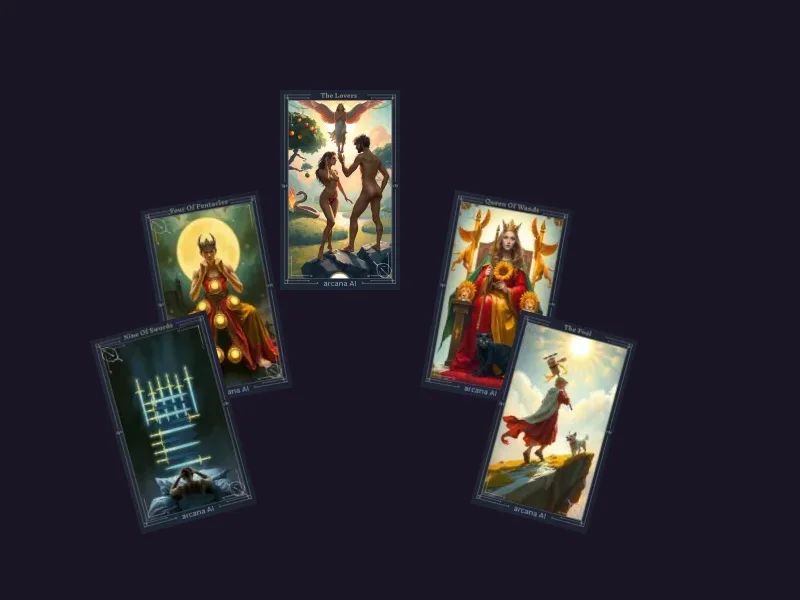
Spread Layout: 5 card(s)
Card Positions
The Root Dilemma
The underlying stakes, hidden pressures, and core motivation driving this crossroads.
Path A Immediate Reality
The initial investment, emotional toll, and early demands of choosing the first option.
Path B Immediate Reality
The initial investment, emotional toll, and early demands of choosing the alternative option.
Path A Long-Term Evolution
Where Path A leads once initial excitement settles, including lessons and lasting payoffs.
Path B Long-Term Evolution
Where Path B leads once initial excitement settles, including lessons and lasting payoffs.
The decision-making tarot spread is a five-card crossroads layout engineered to resolve choice paralysis between two competing paths. By mapping the short-term friction and long-term consequences of both options alongside the core dilemma, the spread reveals hidden trade-offs before you commit resources.
                    [ 1. The Root Dilemma ]
                     (Core Stakes at Center)

        [ 2. Path A Now ]              [ 3. Path B Now ]
      (Immediate Investment)         (Immediate Investment)

     [ 4. Path A Outcome ]          [ 5. Path B Outcome ]
     (Long-Term Trajectory)         (Long-Term Trajectory)
How Symbolic Distance Breaks Choice Paralysis
When you obsess over a high-stakes decision, your brain cycles through the same loops of anxiety and self-doubt. Psychologists call this decision fatigue: the more you weigh pros and cons in your head, the harder it becomes to trust your reasoning.
Tarot provides symbolic distance. By projecting each scenario onto archetypal imagery on a table, you detach from internal panic. You stop asking “What if I ruin my life?” and start examining concrete realities: “What does this card say about my endurance, my budget, or my boundaries?”
Step-by-Step Layout Instructions
Before touching the deck, define your two paths with precision. Avoid vague options like “Option A: be happy; Option B: stay sad.” Use concrete actions: “Option A: submit the resignation letter on Monday; Option B: request a department transfer.”
- Place your hands on the deck and take three steady breaths. Clear any expectation of finding an effortless shortcut.
- Shuffle thoroughly while visualizing the crossroads ahead of you.
- Deal five cards face down in the fork formation:
- Position 1 sits in the upper center.
- Position 2 sits below to the left (Option A short-term).
- Position 3 sits below to the right (Option B short-term).
- Position 4 rests underneath Position 2 (Option A long-term).
- Position 5 rests underneath Position 3 (Option B long-term).
- Turn over Card 1 first to identify the real issue, then reveal the branches in pairs (2 with 3, followed by 4 with 5).
Evaluating the Branches: Direct Comparative Analysis
Card 1: What Is Genuinely at Stake?
Card 1 often surprises the reader. If you think your dilemma is about salary, but Position 1 turns up the Five of Cups, the true issue is unresolved regret or fear of repeating a past failure. Knowing the psychological root prevents choosing a path that addresses the wrong problem.
Cards 2 vs. 3: Comparing the Entry Costs
Every significant change demands an upfront price. Examine the suits across Positions 2 and 3:
If Position 2 draws Swords while Position 3 draws Pentacles, Path A requires intense intellectual exertion, negotiation, and difficult conversations. Path B demands financial restructuring, physical relocation, or routine endurance. Choose based on which resource you currently possess in abundance.
If one branch shows a Major Arcana and the other a Minor Arcana, one path triggers a life overhaul while the other represents an incremental adjustment to your present routine.
Cards 4 vs. 5: Where the Momentum Lands
Short-term discomfort can produce long-term freedom, while easy beginnings can stall out in dead ends. Compare the lower cards against the upper branches:
A rough card in Position 2 that resolves into the Nine of Cups in Position 4 means Path A has a steep learning curve that yields deep contentment. Conversely, an effortless card in Position 3 that collapses into the Four of Swords in Position 5 warns that Option B looks comfortable initially but leads to burnout or stagnation.
Decoding Card Families at a Crossroads
Different suits indicate distinct forms of leverage and risk:
- Swords highlight mental taxation, ethical dilemmas, and communication barriers. They ask whether you have the stomach for tough conversations.
- Pentacles evaluate tangible resources: time, health, cash reserves, and domestic security. They test whether your plan is logistically viable.
- Wands reveal momentum, creative desire, and risk tolerance. They show where your energy ignites versus where it fizzles out.
- Cups track emotional safety, relational harmony, and inner fulfillment. They signal whether a choice feeds your spirit or starves it.
Court cards in your branches point to influential personalities or stances you must adopt. A King indicates that firm boundaries and executive authority are required. A Page suggests you will need to operate as an apprentice, willing to ask basic questions and make mistakes.
Journaling Prompts for Decision Paralysis
Once the cards are on the table, write out answers to these four prompts before making any commitments:
- Looking at the two long-term outcomes (Cards 4 and 5), which form of discomfort am I more prepared to endure?
- Does Card 1 reveal a fear I have been pretending does not exist?
- If I chose Path A and could never talk about it for social validation, would I still want it?
- What is the single smallest action I can take in the next twenty-four hours to test the waters of my preferred path?
No card layout can eliminate life’s uncertainty. What this spread does offer is honest visibility into the trade-offs you must carry, giving you the clarity to step forward with intention.
Example Questions
- Should I accept the new job offer or stay in my current role?
- Should I relocate across the country or establish deeper roots where I live?
- Should I invest my savings into this venture or keep them in reserve?
- Should I have this difficult conversation now or wait for better timing?
Related Spreads
Five-Card Tarot Spread: Cross Geometry & Elemental Balance
A versatile five-card layout bridging simple draws and complex spreads. Explore cross geometry versus linear timelines and master elemental balance audits.
Problem-Solution Tarot Spread
A focused two-card layout diagnosing the true root cause of an obstacle and identifying the most effective strategic action or mindset required to resolve it.
Two-Card Tarot Spread: Polarity Analysis & Card Dialogues
A focused two-card layout for resolving dilemmas, contrasting perspectives, and reading fluid dialogue between cards through polarity analysis.
Try This Spread
Experience this spread with Arcana AI
Get the AppFrequently Asked Questions
Can tarot make the decision for me?
Tarot illuminates subconscious trade-offs and unexamined consequences, but it cannot make decisions on your behalf. Personal responsibility and free will remain entirely yours.
What if both paths show challenging cards?
Challenging cards on both branches signal that any worthwhile transition demands hard work. Compare the nature of the challenges: one path may require logistical patience, while the other demands uncomfortable emotional honesty.
Can this spread handle more than two choices?
You can add a third branch with positions for Path C immediate reality and Path C outcome. Keeping spreads to two clear options, however, prevents mental clutter and produces sharper contrast.
What should I do if the cards seem contradictory?
Contradictions usually reflect your own ambivalence. If a card indicates success while another suggests fear, you likely crave the reward but dread the visibility or workload that comes with it.