Two-Card Tarot Spread: Polarity Analysis & Card Dialogues
A focused two-card layout for resolving dilemmas, contrasting perspectives, and reading fluid dialogue between cards through polarity analysis.
The Answers You Seek Are Already Within You
AI-powered tarot to help you find clarity when you need it most.
Daily wisdom at your fingertips • Zero commitment • Deepen your practice with your free account
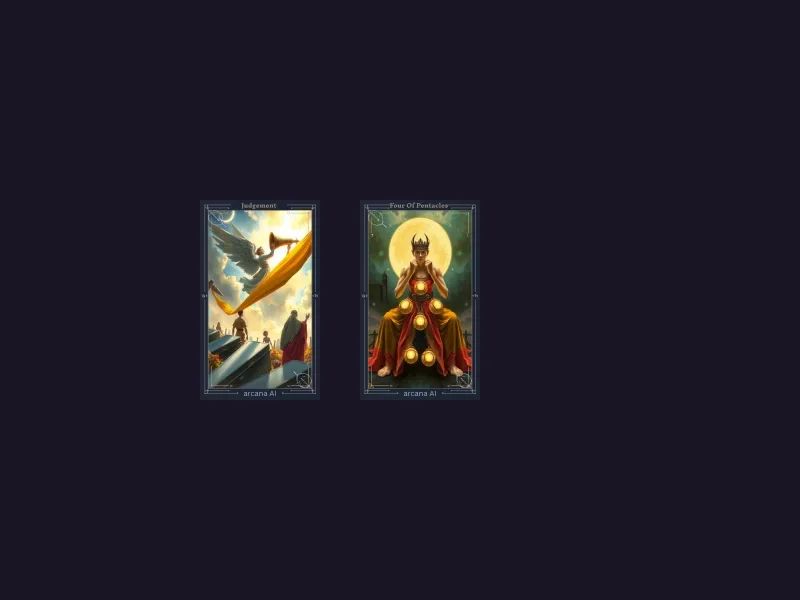
Spread Layout: 2 card(s)
Card Positions
Thesis (First Pole)
Represents the initial perspective, present circumstance, active impulse, or your conscious position in a dynamic.
Antithesis (Second Pole)
Represents the counterpoint, hidden friction, external influence, or complementary advice needed to resolve the first card.
The Grammar of Pairing
Reading a single tarot card gives you a focused archetype, like a noun standing alone on a page. Adding a second card introduces syntax.
With two cards, you create an active circuit: subject and modifier, cause and friction, or catalyst and consequence.
The Two-Card Spread is often treated as a stepping-stone for beginners who find large spreads overwhelming. In practice, seasoned practitioners use two-card pulls because they mirror the dualities of real life. Most human dilemmas are not ten-part sagas; they are tug-of-wars between two competing impulses, two choices, or two people trying to understand each other.
       ┌───────────────┐               ┌───────────────┐
       │               │   Dialogue    │               │
       │   [ Pos 1 ]   │◄─────────────►│   [ Pos 2 ]   │
       │  First Pole   │   & Tension   │  Second Pole  │
       │   (Thesis)    │               │ (Antithesis)  │
       │               │               │               │
       └───────────────┘               └───────────────┘
Polarity Analysis Frameworks
The most effective two-card readings define the exact relationship between the two positions before shuffling. Here are four practical frameworks for structuring binary inquiries:
1. Action vs. Inaction (Push vs. Wait)
When you feel stuck between wanting to force an outcome and worrying that pushing will backfire:
- Card 1 (Action): What energy enters the situation if you initiate immediately?
- Card 2 (Inaction): What unfolds naturally if you hold your ground and let external forces develop?
If Card 1 is the Knight of Swords and Card 2 is the Four of Swords, the cards are contrasting aggressive tactical confrontation with strategic rest. The contrast shows that immediate action creates conflict, while waiting preserves your strength for a better opening.
2. You vs. Them (The Relational Mirror)
In difficult negotiations, personal conflicts, or team disputes, you only have access to your own inner narrative:
- Card 1 (Your Reality): The core need, emotional posture, or unspoken expectation you bring into the room.
- Card 2 (Their Reality): The pressures, defensive walls, or motives governing the other party.
Notice whether Card 1 and Card 2 share an element. If you draw the Ten of Wands (exhausted overwork) while the other person draws the Seven of Cups (paralyzed by ungrounded options), your conflict is not personal hostility. You are exhausted by logistics while they are lost in speculation. Recognizing that difference dissolves unnecessary defensiveness.
3. Opportunity vs. Hidden Cost (Pros and Cons)
Every new project, job offer, or financial venture carries trade-offs that enthusiasm can blind you to:
- Card 1 (The Genuine Upside): The primary value, growth, or leverage this path offers.
- Card 2 (The Hidden Tax): The emotional, physical, or financial cost required to sustain it.
Drawing the Three of Wands in Card 1 emphasizes legitimate expansion and horizon growth; drawing the Five of Pentacles in Card 2 warns that this venture will strain cash reserves or create temporary material isolation before it pays off.
4. Conscious Objective vs. Subconscious Driver
When you set clear goals but repeatedly procrastinate or sabotage your own progress:
- Card 1 (Conscious Goal): What you tell yourself you are trying to achieve.
- Card 2 (Subconscious Driver): The hidden emotional need or protective fear pulling the levers behind the scenes.
If Card 1 is the Ace of Pentacles (wanting a stable, new business contract) and Card 2 is The Moon (fear of being exposed or failing publicly), your obstacle is emotional, not procedural. You do not need a new planner; you need to address your fear of visibility.
Reading Fluid Card Dialogues
When two cards sit side-by-side, do not read their textbook definitions separately and concatenate them. Read how they interact dynamically.
1. Visual Gaze and Body Language
Modern tarot decks are rich in directional cues. How the figures on the cards look at each other changes the meaning:
- Facing each other: The archetypes are in direct dialogue, confrontation, or mutual agreement. If the Queen of Swords faces the Page of Cups, mature discernment is directly evaluating emotional vulnerability.
- Looking away (backs turned): The two forces are in active avoidance, denial, or irreconcilable misalignment. When figures turn their backs on each other, unresolved tension is being ignored.
- Facing the same direction: The cards are working in tandem toward a shared horizon or running away from the same threat.
2. Elemental Compatibility and Friction
Each card belongs to an element (Fire, Water, Air, or Earth). How these elements interact determines whether the pair creates momentum or friction:
| Elemental Pairing | Interaction Dynamic | Practical Reading Interpretation |
|---|---|---|
| Fire + Air | Mutual amplification. Air fuels Fire; Fire warms Air. | Rapid ideas translating into swift, decisive execution. Watch out for impulsiveness or burnout. |
| Water + Earth | Grounded nourishment. Earth channels Water; Water softens Earth. | Sustainable emotional security, steady creative manifestation, and realistic long-term planning. |
| Fire + Water | Volatility and steam. Fire evaporates Water; Water extinguishes Fire. | Emotional reactivity clashing with passionate will. Frustration, mixed signals, or dramatic mood swings. |
| Air + Earth | Dry practicality. Air analyzes; Earth measures tangible reality. | Highly structured, analytical planning. Efficient for budgets and legal work, but lacking emotional warmth. |
| Same Element | Intense concentration of one life sphere. | Doubling down on that space. Two Cups indicate profound emotional immersion; two Swords point to mental gridlock. |
The “Third Invisible Card” Synthesis Technique
One of the most powerful techniques in two-card reading is calculating the unstated synthesis, the invisible third card that resolves the tension between the pair.
You can derive this intuitively or numerologically:
- Note the numbers of both cards (Major Arcana use their Roman numeral; Minor Arcana use their rank from 1 to 10; Court cards can be assigned Page=11, Knight=12, Queen=13, King=14).
- Add the numbers together. If the sum exceeds 21, reduce it by adding the digits (e.g., 25 becomes 2 + 5 = 7).
- Look up the corresponding Major Arcana card. That archetype represents the bridge between your two cards.
For instance, if your two cards are The Magician (1) and The Hierophant (5), their sum is 6: The Lovers. The resolution between individual agency (The Magician) and institutional tradition (The Hierophant) requires conscious personal choice and values alignment (The Lovers).
Handling Reversals in Pairings
Reversals in a two-card spread show where energy is blocked, unevenly distributed, or operating internally:
- Upright + Reversed: A dynamic where one force is clear and actionable, while the other is tangled or meeting resistance. For example, an upright King of Wands paired with a reversed Two of Pentacles suggests strong leadership drive that is being derailed by chaotic scheduling and dropped balls.
- Both Reversed: Subconscious gridlock. Neither side of the duality is moving forward cleanly. This indicates that external action should pause until inner clarity is restored.
- Complementary Reversals: Sometimes a reversed card is exactly what an upright card needs. An upright Knight of Swords (rushing ahead aggressively) paired with a reversed Seven of Wands (dropping your defensive guard) advises you to stop fighting unnecessary battles and focus entirely on your direct goal.
Quick Two-Card Daily Practice
To sharpen your pairing intuition without burning out, try this three-minute morning routine:
- Shuffle your deck and draw two cards side-by-side.
- Formulate one sentence combining both cards without using the word “and.” (For example: “My creative enthusiasm (Page of Wands) is grounded by rigorous editing (Queen of Swords).”)
- Close the deck. Notice how throughout the day, having framed the cards as a dialogue prevents fragmented thinking and strengthens your intuitive synthesis.
Example Questions
- What happens if I take immediate action versus if I wait?
- What is my conscious intention versus my subconscious hesitation?
- How do I see this dynamic versus how the other person experiences it?
- What is the primary benefit versus the hidden risk of this choice?
- What attitude should I adopt to balance this active challenge?
Related Spreads
Decision-Making Tarot Spread: 5-Card Crossroads Layout
A strategic five-card layout for handling life's crossroads and making informed decisions. Explores your current situation, available paths, potential outcomes, and the best course of action.
One Card Tarot Spread: Focus Frameworks & Daily Practice
A single card delivers unclouded insight when paired with the right inquiry. Learn focus question frameworks, daily anchor routines, and clear interpretation methods.
Problem-Solution Tarot Spread
A focused two-card layout diagnosing the true root cause of an obstacle and identifying the most effective strategic action or mindset required to resolve it.
Three Card Tarot Spread: 15 Variations & Guide | Arcana AI
A foundational three-card layout exploring past influences, present circumstances, and future potential. Perfect for daily guidance, decisions, and relationship insights.
Try This Spread
Experience this spread with Arcana AI
Get the AppFrequently Asked Questions
How do you read two tarot cards together as a story?
Begin by tracking visual cues: notice whether the figures face each other or look away, and check how the suits interact elementally. Instead of defining each card in isolation, treat Card 1 as a noun or subject and Card 2 as an adjective or modifying verb, creating a single coherent sentence.
Can a two-card spread answer 'either/or' decision questions?
Yes, provided you assign each card to one specific option before drawing (e.g., Card 1 for Option A, Card 2 for Option B). Compare the elemental stability, emotional tone, and long-term implications of each option rather than looking for a simplistic good-or-bad verdict.
What does it mean when both cards in a two-card draw are reversed?
When both cards arrive reversed, the situation is heavily bottlenecked by internal friction, miscommunication, or passive resistance. The pairing indicates that external progress is stalled until you resolve subconscious conflict or clarify underlying motives.
How does elemental dignity work between two cards?
Cards interact like physical elements. Fire and Air feed and accelerate each other; Water and Earth create grounded, nourishing stability. Conversely, Fire and Water clash into emotional volatility, and Air and Earth can feel dry, detached, or overly rigid.