Five-Card Tarot Spread: Cross Geometry & Elemental Balance
A versatile five-card layout bridging simple draws and complex spreads. Explore cross geometry versus linear timelines and master elemental balance audits.
The Answers You Seek Are Already Within You
AI-powered tarot to help you find clarity when you need it most.
Daily wisdom at your fingertips • Zero commitment • Deepen your practice with your free account
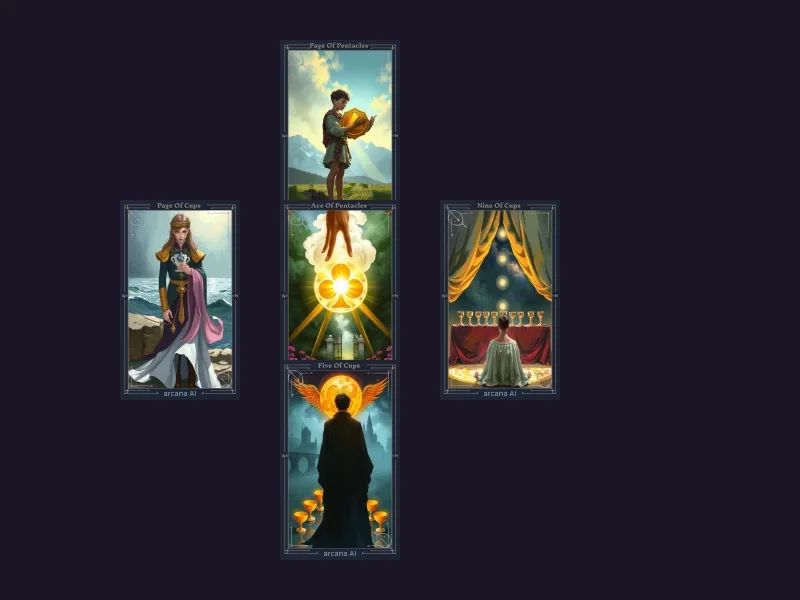
Spread Layout: 5 card(s)
Card Positions
The Center (Present Nexus)
The core reality and immediate focal point of your question, anchoring the intersection of time and consciousness.
The Left (Past Foundation)
The historical catalyst, unexamined habit, or recent decision providing the momentum behind your current state.
The Right (Immediate Trajectory)
Where events naturally flow if no active adjustments are made to your present momentum.
The Crown (Conscious Guidance)
Higher counsel, intentional mindset, and conscious aspirations offering strategic clarity.
The Root (Subconscious Anchor)
Unconscious motivations, hidden structural support, or alternative perspectives operating beneath awareness.
The Sweet Spot of Tarot Architecture
A three-card spread is quick and punchy, but it often flattens complex situations into a simple past, present, and future timeline. Conversely, a ten-card Celtic Cross provides exhaustive detail, but its sprawling narrative can leave you feeling drowning in contradictory symbols.
The Five-Card Spread sits in the architectural sweet spot. Five cards give you enough structural room to evaluate timelines, subconscious drivers, and tactical advice, all while keeping the central message clear enough to act on immediately.
To master this spread, you need to understand two distinct ways to arrange the cards: spatial cross geometry and chronological linear progression.
Cross Geometry vs. Linear Timelines
The layout you choose dictates how your brain organizes the cards. Match the geometry to the nature of your inquiry.
Layout Option A: Cross Geometry (Spatial and Psychological)
Cross geometry is best when your situation involves internal conflict, unstated motives, or multidimensional life decisions where time is only one element among many.
                  ┌───────────────┐
                  │   [ Pos 4 ]   │
                  │   The Crown   │
                  │ (Conscious)   │
                  └───────┬───────┘
                          │
  ┌───────────────┐┌──────┴───────┐┌───────────────┐
  │   [ Pos 2 ]   ││   [ Pos 1 ]   ││   [ Pos 3 ]   │
  │   The Roots   ││  The Center  ││ The Horizon   │
  │    (Past)     ││ (Present)    ││   (Future)    │
  └───────────────┘└──────┬───────┘└───────────────┘
                          │
                  ┌───────┴───────┐
                  │   [ Pos 5 ]   │
                  │   The Root    │
                  │ (Subconscious)│
                  └───────────────┘
In this layout, two axes intersect:
- The Horizontal Axis (Time & Movement): Card 2 (Past) flowing into Card 1 (Present) and resolving into Card 3 (Future). This shows momentum, cause, and immediate consequence.
- The Vertical Axis (Awareness & Depth): Card 5 (The Subconscious Root) grounding Card 1, while Card 4 (The Conscious Crown) points toward deliberate aspiration and higher guidance.
Layout Option B: The Linear Timeline (Causal Progression)
The linear layout is ideal when you are managing a project launch, career transition, or specific sequence of events where chronological order matters most.
┌─────────┐   ┌─────────┐   ┌─────────┐   ┌─────────┐   ┌─────────┐
│ [Pos 1] │   │ [Pos 2] │   │ [Pos 3] │   │ [Pos 4] │   │ [Pos 5] │
│ Current │──►│ Root /  │──►│ Hidden  │──►│ Best    │──►│ Likely  │
│ Baseline│   │ Origin  │   │ Friction│   │ Action  │   │ Outcome │
└─────────┘   └─────────┘   └─────────┘   └─────────┘   └─────────┘
This arrangement reads like a chapter book. Each card triggers the next, making it simple to pinpoint exactly where momentum is stalling.
The 5 Positions in Cross Geometry
When using the Cross Layout, interpret each station according to its spatial placement:
Position 1: The Center (Present Reality)
This card represents your immediate nexus. It cuts through wishful thinking and shows the prevailing energetic temperature of your dilemma right now. If the center card is the Two of Swords, you are in active denial or refusing to make a call; if it is the Sun, clarity and vitality are already present if you choose to step into them.
Position 2: The Left (Past Influences)
Sitting to the left of the center, this card reveals what has brought you to this threshold. It is not distant childhood history; it emphasizes recent decisions, habits, or relationship dynamics that created the current momentum.
Position 3: The Right (Future Horizon)
This card shows the projected trajectory over the next one to three months if you make no changes to your current habits. It is not an unchangeable fate. Treat it as a weather forecast indicating what will arrive unless you change direction.
Position 4: The Crown (Conscious Guidance)
Perched above the center, Position 4 represents your highest intentional perspective. It offers strategic counsel, advising you on what attitude to adopt, what boundaries to enforce, and how to stay aligned with your core values.
Position 5: The Root (Subconscious Anchor)
Sitting at the base, Position 5 reveals what is happening under the surface. It exposes unexamined fears, implicit biases, or hidden resources you are drawing on without realizing it. Comparing Card 4 (conscious goal) with Card 5 (subconscious driver) often explains why you feel divided.
Conducting an Elemental Balance Audit
Before analyzing individual card meanings, step back and count the elemental distribution across your five cards. In a spread of five, elemental concentration reveals where your life energy is pooling or draining.
| Dominant Element | What It Signals | What You Need to Watch |
|---|---|---|
| Fire (Wands heavy: 3+ cards) | High motivation, rapid action, passion, entrepreneurial drive. | Impulsiveness, impatient communication, risk of physical burnout. |
| Water (Cups heavy: 3+ cards) | Deep emotional processing, intuitive clarity, relationship focus. | Over-identification with moods, boundary leaks, analysis paralysis. |
| Air (Swords heavy: 3+ cards) | Intellectual rigor, strategic planning, conflict resolution. | Anxious insomnia, hyper-criticism, detachment from bodily reality. |
| Earth (Pentacles heavy: 3+ cards) | Tangible progress, financial consolidation, practical stability. | Stubborn inertia, resistance to necessary changes, material hoarding. |
The Power of Missing Elements
What is absent from a reading is frequently more informative than what is present:
- No Earth: You have brilliant plans and intense passion, but you lack the practical habits, budget, or calendar discipline to execute them.
- No Air: The situation is flooded with emotional reaction and hasty action, but nobody is taking a detached, objective look at the data.
- No Water: Decisions are being made strictly on logic or speed, ignoring how people actually feel. Resentment is quietly building.
- No Fire: The structure is solid and everyone agrees, but the project lacks vitality, courage, and enthusiasm to move forward.
Interpreting Major Arcana Density
In a five-card spread, note how many Major Arcana cards land on the table:
- Zero to One Major Arcana: This is an everyday, operational matter. Focus on practical communication, calendar adjustments, and tactical problem-solving.
- Two Major Arcana: A transitional phase. Daily logistics are important, but they are serving as testing grounds for personal maturity.
- Three or More Major Arcana: An archetypal milestone. You are handling an existential turning point (such as a career overhaul, divorce, spiritual awakening, or major relocation). Trying to force trivial short-term fixes will fail; focus on inner surrender and long-term alignment.
Step-by-Step Five-Card Reading Routine
- Select your geometry: Pick either the Cross Layout (for psychological dilemmas) or Linear Layout (for chronological projects).
- Shuffle and cut: Focus on your central question without overcomplicating the phrasing.
- Conduct the bird’s-eye audit: Count your Major Arcana and review your elemental balance before reading text definitions.
- Read the central anchor: Identify Card 1 first. Everything else in the spread modifies this card.
- Trace the axes: In the cross layout, read Card 2 through Card 3 (the timeline), then Card 5 through Card 4 (the depth).
- Formulate one actionable takeaway: Condense the reading into a single sentence you can test over the coming week.
The Five-Card Spread offers a durable, elegant framework for everyday decision-making. By balancing clear spatial geometry with elemental auditing, you turn five cards into a precise diagnostic compass for any challenge.
Example Questions
- What underlying dynamics are governing this complex decision?
- Where is my current path leading, and what adjustment is advised?
- How do my subconscious beliefs affect my conscious professional goals?
- What hidden factor is influencing this relational conflict?
- What mindset best bridges my past experience with my future goals?
Related Spreads
Decision-Making Tarot Spread: 5-Card Crossroads Layout
A strategic five-card layout for handling life's crossroads and making informed decisions. Explores your current situation, available paths, potential outcomes, and the best course of action.
Horseshoe Tarot Spread: 7-Position Progression & Outcome Pivots
A 7-card kinetic arc mapping your situation from past catalyst to probable outcome, with actionable advice to shift the central apex obstacle.
Problem-Solution Tarot Spread
A focused two-card layout diagnosing the true root cause of an obstacle and identifying the most effective strategic action or mindset required to resolve it.
Three Card Tarot Spread: 15 Variations & Guide | Arcana AI
A foundational three-card layout exploring past influences, present circumstances, and future potential. Perfect for daily guidance, decisions, and relationship insights.
Try This Spread
Experience this spread with Arcana AI
Get the AppFrequently Asked Questions
When should I use a cross layout instead of a linear 5-card layout?
Use the cross layout when exploring internal psychology, conscious versus subconscious dynamics, or multidimensional dilemmas where time is only one factor. Use a linear layout when evaluating a clear sequential timeline, project milestones, or step-by-step causal progressions.
How do you evaluate elemental balance in a 5-card spread?
Count the suits among your cards. A balanced reading contains a spread of elements. If an element is heavily dominant (e.g., three or four Wands), that area of life dominates your focus. If an element is completely absent, it emphasizes your blind spot, such as missing Earth indicating a lack of practical execution.
Is the Five-Card Spread better than the Celtic Cross?
It is often more practical. While the 10-card Celtic Cross offers sprawling historical and psychological depth, the 5-card spread provides the necessary nuance without the cognitive overload or narrative drift that frequently muddies larger spreads.
What does it mean if 3 or more Major Arcana appear in a 5-card spread?
Having three or more Major Arcana in a five-card spread indicates you are handling a major life milestone, existential transition, or karmic turning point where external events are less about daily logistics and more about deep personal evolution.