Celtic Cross Tarot Spread: 10-Card Layout & Guide
The classic 10-card tarot layout providing deep diagnostic insight. Explores conscious and subconscious forces, external conditions, and potential outcomes.
The Answers You Seek Are Already Within You
AI-powered tarot to help you find clarity when you need it most.
Daily wisdom at your fingertips • Zero commitment • Deepen your practice with your free account
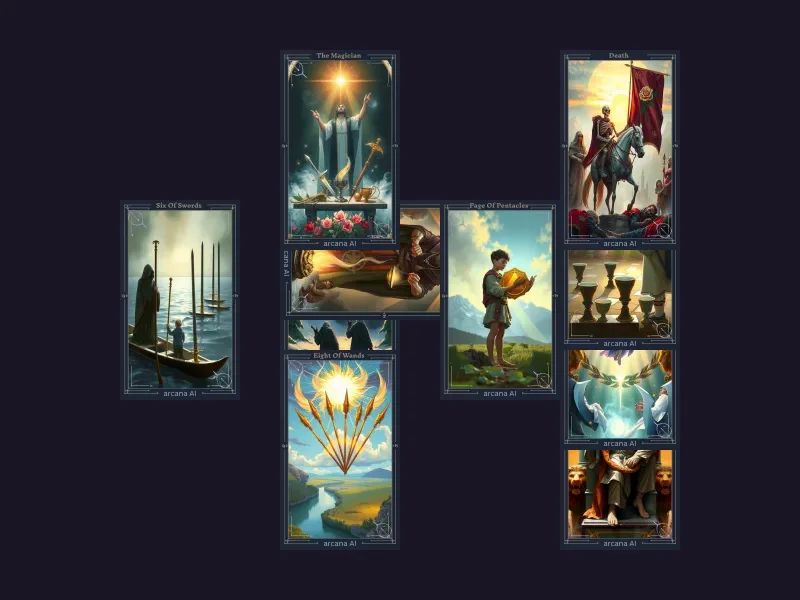
Spread Layout: 10 card(s)
Card Positions
Present Situation
The core theme and immediate reality. Shows where your focus sits at this moment and anchors the entire reading.
Challenge and Crossing
The immediate obstacle, friction, or catalyst crossing the first card. Highlights what demands resolution.
Distant Past and Roots
Foundational events and long-term habits that created current circumstances. Shows where the pattern originated.
Recent Past
Influences and decisions just behind you that are beginning to fade but still shape current reactions.
Conscious Goals
What you consciously strive for, your stated intentions, and the outcome you believe you want.
Subconscious Drivers
Underlying motivations, hidden fears, and unacknowledged desires operating below conscious awareness.
Self-Perception and Agency
How you view yourself within the situation, your attitude, and the personal power you bring to the table.
External Environment
People, workplaces, social pressures, and environmental constraints operating outside your direct control.
Hopes and Fears
The psychological knot of what you desire most versus what you dread. Often reveals internal resistance.
Final Outcome
The natural culmination of existing momentum if your actions, mindset, and circumstances stay on their current course.
What Is the Celtic Cross Tarot Spread?
The Celtic Cross tarot spread is a comprehensive 10-card layout used to diagnose complex situations. Documented by Arthur Edward Waite in 1909, this spread maps out the relationship between internal psychology, personal history, environmental pressures, and probable outcomes.
While simple spreads handle daily check-ins, the Celtic Cross is designed for turning points. When facing major career crossroads, deep relationship dilemmas, or personal transitions, ten cards provide enough dimensional context to explain not just what is happening, but why the pattern developed and how to resolve it.
The 10 Positions of the Celtic Cross Explained
The layout divides naturally into two distinct components: the central circle or cross (Cards 1 through 6) and the vertical staff on the right (Cards 7 through 10).
The Central Cross: Core Psychology and Immediate Reality
The six cards on the left establish the foundation of the issue:
- Position 1 (The Present Situation): The central card represents the primary topic or feeling occupying your attention today. It establishes the baseline reality of the inquiry.
- Position 2 (The Crossing Challenge): Laid horizontally across the first card, this card shows what obstructs or complicates the situation. Even an uplifting card here can indicate an obstacle, such as overconfidence or excessive optimism.
- Position 3 (The Distant Past / Root Cause): Placed below the cross, this position shows the foundational experiences, childhood habits, or past choices that seeded the current dilemma.
- Position 4 (The Recent Past): Placed to the left, this card reflects events or shifts that took place recently. The energy here is beginning to recede, but its aftermath still colors your present choices.
- Position 5 (Conscious Goals / The Crown): Placed above the cross, this card reveals what you consciously aim for. It represents your deliberate ambitions, rational expectations, and what you tell yourself you want to happen.
- Position 6 (Subconscious Drivers / The Undercurrent): Placed to the right, this position uncovers deeper motives, unexamined fears, and instinctual needs operating beneath your awareness.
The Staff: External Context and Trajectory
The four vertical cards on the right evaluate how your inner state interacts with the world:
- Position 7 (Self-Perception and Agency): Reflects your current mindset, self-image, and attitude. It shows whether you feel empowered, defeated, or detached within the situation.
- Position 8 (External Environment): Details outside forces affecting you. This includes coworkers, family members, market trends, or institutional rules beyond your direct control.
- Position 9 (Hopes and Fears): Pinpoints the emotional tension surrounding the question. What you hope for and what you fear are often two sides of the same expectation, exposing where you hold psychological resistance.
- Position 10 (Final Outcome): Synthesizes the preceding nine positions to show where existing momentum leads. It is not an unbending prediction, but a clear forecast of where you land if nothing changes.
Key Card Pairings: Reading the Cross in Dialogue
Treating ten cards as isolated definitions leads to information overload. The most effective way to interpret the Celtic Cross is by pairing complementary positions across four primary axes.
1. The Core Tension (Positions 1 and 2)
Read the central cross first. How does the crossing card modify the present situation? If Card 1 is the Nine of Pentacles (self-reliance) and Card 2 is the Three of Cups (social collaboration), your challenge may involve difficulty asking others for help or integrating into a group.
2. The Internal Alignment Axis (Positions 5 and 6)
Compare your conscious ambition against your subconscious reality:
- When Cards 5 and 6 share the same suit or harmonic elements, your conscious intentions and underlying drives work in harmony.
- When Card 5 is an ambitious wand card and Card 6 is a defensive swords card, your rational desire to start a new project is being sabotaged by an unacknowledged fear of failure.
3. The Agency vs Environment Axis (Positions 7 and 8)
Look at how your inner attitude compares with your external surroundings:
- If Card 7 is The Emperor and Card 8 is the Five of Swords, you are maintaining personal discipline in a hostile or disorganized workplace.
- If Card 7 is the Eight of Swords and Card 8 is the Three of Pentacles, the environment is supportive and collaborative, meaning the feeling of being trapped originates entirely in your own assumptions.
4. The Bridge to Outcome (Positions 2, 9, and 10)
Connect the challenge to the resolution:
- Card 2 states the obstacle you must find.
- Card 9 reveals the emotional resistance holding you back from doing so.
- Card 10 shows the realistic result once those variables interact.
Celtic Cross in Practice: A Complete Sample Reading
To see how these threads weave together, imagine someone asking about leaving their company to start an independent creative studio:
- Card 1 (Present): Eight of Pentacles. The querent has developed strong craft and reliable working habits over years of steady labor.
- Card 2 (Crossing): Two of Wands. Standing on the battlement holding a globe, the challenge is chronic hesitation at the threshold of a new venture.
- Card 3 (Roots): Ten of Pentacles. A background rooted in corporate stability and familial expectations that prioritize steady income over entrepreneurial risk.
- Card 4 (Recent Past): Four of Swords. A recent period of burnout or mental fatigue that prompted them to rethink their lifestyle.
- Card 5 (Conscious): The Magician. A clear, stated goal to take control of their career and manifest creative autonomy.
- Card 6 (Subconscious): Five of Pentacles. A deep-seated worry about material poverty and social exclusion if the business stumbles.
- Card 7 (Self): King of Cups. Emotional maturity, calm demeanor, and steady self-containment.
- Card 8 (Environment): Six of Wands. Strong encouragement from peers, professional recognition, and client interest waiting in the wings.
- Card 9 (Hopes/Fears): Seven of Cups. Fear of being overwhelmed by too many options or chasing unrealistic fantasies.
- Card 10 (Outcome): The Chariot. Decisive victory and rapid forward momentum achieved through focused will and clear boundaries.
Notice the diagnosis: the market is receptive (Card 8) and skill is verified (Card 1), but the querent’s lingering fear of scarcity (Card 6) creates decision paralysis (Card 2). Overcoming that internal hesitation leads directly to triumphant independence (Card 10).
Step-by-Step: How to Lay Out and Read the Celtic Cross
- State a focused inquiry: Frame a clear, open-ended question about your situation rather than a simple binary choice.
- Shuffle and clear the deck: Mix the cards until you reach a natural stopping point. Cut the deck into three stacks and restack them.
- Lay out Cards 1 through 6: Place Card 1 in the center, cross it with Card 2, place Card 3 below, Card 4 to the left, Card 5 above, and Card 6 to the right.
- Build the vertical staff: Place Card 7 to the right of the cross at the bottom, then stack Cards 8, 9, and 10 upward in a column.
- Analyze the pairings: Read the central tension first, inspect the conscious/subconscious split, and evaluate external support before examining the final outcome.
- Identify your action step: Extract one tangible decision you can make in the present to align with the guidance.
Multi-Card Pattern Recognition with Arcana AI
Synthesizing ten cards simultaneously can challenge even experienced readers. Arcana AI processes the entire spread holistically, analyzing how suit majorities, elemental tensions, and position pairings interact.
Instead of generic card lookups, Arcana AI traces the continuous narrative from Card 1 through Card 10, clarifying how your conscious intentions and subconscious hesitations shape your path forward.
Frequently Asked Questions About the Celtic Cross
How does the Celtic Cross tarot spread work?
The Celtic Cross arranges 10 cards into two structures: a central six-card cross exploring internal and historical factors, and a vertical four-card staff evaluating external conditions, self-perception, and potential outcomes.
Why is the Celtic Cross so popular?
It provides a balanced diagnostic view of a dilemma. Instead of offering an isolated yes or no, it maps personal mindset, hidden motives, environmental pressures, and timeline momentum in one view.
Which positions in the Celtic Cross are most important?
Positions 1 and 2 form the heart of the spread, establishing the main dilemma and its immediate friction. Positions 5 and 6 reveal whether your conscious goals align with your subconscious drivers.
Does Position 10 represent an unchangeable fate?
No. Position 10 reflects where current momentum leads. If you alter your mindset in Position 7 or adjust how you handle the challenge in Position 2, the outcome shifts.
Can a beginner read the Celtic Cross?
Yes, though it helps to break the reading down into card pairs rather than attempting to interpret all ten cards simultaneously.
How long does a full Celtic Cross reading take?
A thoughtful reading usually takes 20 to 45 minutes to analyze card pairings, suit balances, and practical takeaways.
Related Spreads for Further Exploration
To expand your tarot practice, explore these complementary layouts:
- Three Card Spread: A fast, modular layout for everyday timeline, decision, or relationship check-ins.
- Nine Card Spread: A 3x3 grid that maps conscious and subconscious currents across past, present, and future.
- Horseshoe Spread: A traditional 7-card arc that tracks progressive developments through immediate obstacles to resolution.
Example Questions
- What underlying factors are shaping this major life transition?
- How can I resolve the central conflict in my career right now?
- What unseen dynamics are influencing my long-term relationship?
- Where is my current spiritual and personal path leading?
- How do I align my conscious goals with my deeper values?
Related Spreads
Horseshoe Tarot Spread: 7-Position Progression & Outcome Pivots
A 7-card kinetic arc mapping your situation from past catalyst to probable outcome, with actionable advice to shift the central apex obstacle.
Nine Card Tarot Spread: 3x3 Grid Layout & Guide | Arcana AI
A structured 3x3 grid layout mapping past, present, and future across material, emotional, and intellectual dimensions for holistic guidance.
Three Card Tarot Spread: 15 Variations & Guide | Arcana AI
A foundational three-card layout exploring past influences, present circumstances, and future potential. Perfect for daily guidance, decisions, and relationship insights.
Try This Spread
Experience this spread with Arcana AI
Get the AppFrequently Asked Questions
How does the Celtic Cross tarot spread work?
The Celtic Cross arranges 10 cards into two structures: a central six-card cross exploring internal and historical factors, and a vertical four-card staff evaluating external conditions, self-perception, and potential outcomes.
Why is the Celtic Cross so popular?
It provides a balanced diagnostic view of a dilemma. Instead of offering an isolated yes or no, it maps personal mindset, hidden motives, environmental pressures, and timeline momentum in one view.
Which positions in the Celtic Cross are most important?
Positions 1 and 2 form the heart of the spread, establishing the main dilemma and its immediate friction. Positions 5 and 6 reveal whether your conscious goals align with your subconscious drivers.
Does Position 10 represent an unchangeable fate?
No. Position 10 reflects where current momentum leads. If you alter your mindset in Position 7 or adjust how you handle the challenge in Position 2, the outcome shifts.
Can a beginner read the Celtic Cross?
Yes, though it helps to break the reading down into card pairs rather than attempting to interpret all ten cards simultaneously.
How long does a full Celtic Cross reading take?
A thoughtful reading usually takes 20 to 45 minutes to analyze card pairings, suit balances, and practical takeaways.