Nine Card Tarot Spread: 3x3 Grid Layout & Guide
A structured 3x3 grid layout mapping past, present, and future across material, emotional, and intellectual dimensions for holistic guidance.
The Answers You Seek Are Already Within You
AI-powered tarot to help you find clarity when you need it most.
Daily wisdom at your fingertips • Zero commitment • Deepen your practice with your free account
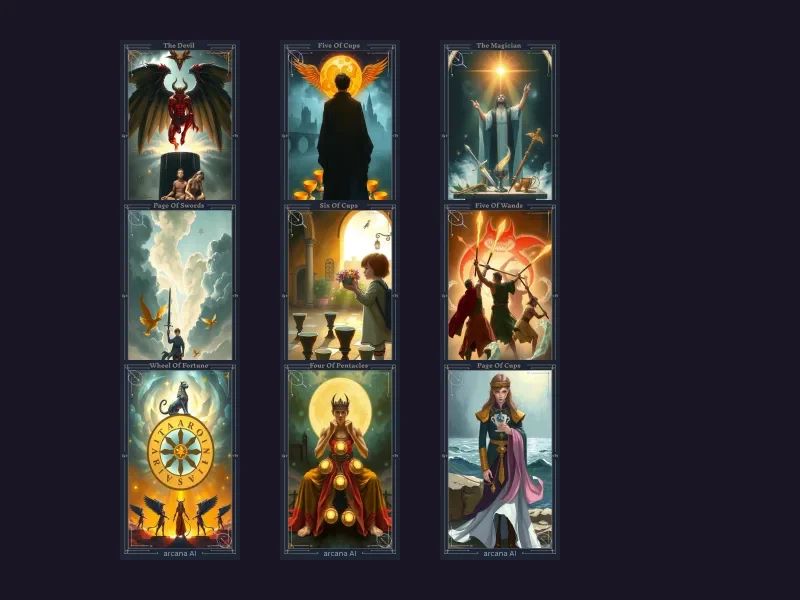
Spread Layout: 9 card(s)
Card Positions
Past Foundation
Foundational events and physical circumstances that originated this chapter.
Past Emotional Core
Emotional experiences and relationship patterns that shaped your feelings.
Past Mindset
Beliefs, mental models, and lessons learned from past experiences.
Present Foundation
Current physical circumstances, finances, and material realities.
The Center Stone
The energetic heart of the entire situation. The key anchor connecting all axes.
Present Mindset
Current thoughts, analytical clarity, and communication habits.
Future Foundation
Tangible outcomes, career trajectory, and practical manifestations ahead.
Future Emotional Reality
Relational growth, emotional fulfillment, and inner healing on the horizon.
Future Culmination
The synthesis of all currents, revealing the ultimate lesson and long-term resolution.
Understanding the 3x3 Nine Card Tarot Spread
The nine card tarot spread is an analytical 3x3 grid layout designed to map out complex life situations across both time and personal dimensions. By placing nine cards in three intersecting rows and three vertical columns, the spread allows you to evaluate how your practical circumstances, emotional responses, and mental clarity interact.
Many tarot spreads follow either a strictly linear timeline or a circular symbolic geometry. The 3x3 grid does something distinct: it organizes your life into a matrix. Instead of treating your feelings and finances as unrelated topics, the grid displays exactly how your past practical choices created your current emotional stress, and where those combined energies lead next.
       Column 1 (Material)    Column 2 (Emotional)    Column 3 (Mental)
Row 1: [ 1: Past Foundation ] [ 2: Past Heart     ] [ 3: Past Mind      ]
Row 2: [ 4: Present Base    ] [ 5: Center Stone   ] [ 6: Present Mind   ]
Row 3: [ 7: Future Base     ] [ 8: Future Heart   ] [ 9: Future Culm.   ]
How to Read the 3x3 Grid: Rows, Columns, and Diagonals
The real power of a 3x3 grid lies in reading its intersecting axes rather than treating each position as an isolated card.
Reading the Horizontal Rows: The Timeline
The three horizontal rows tell the chronological story of your inquiry:
- Row 1 (Top Row - The Past): Cards 1, 2, and 3 reveal the historical groundwork. Card 1 shows what happened practically, Card 2 shows what you felt, and Card 3 shows what beliefs you formed.
- Row 2 (Middle Row - The Present Reality): Cards 4, 5, and 6 define your active situation. Card 5 serves as the anchor stone for the entire reading, flanked by your current physical resources (Card 4) and mental outlook (Card 6).
- Row 3 (Bottom Row - Future Trajectory): Cards 7, 8, and 9 illustrate the probable resolution. Card 7 indicates practical developments, Card 8 shows emotional growth, and Card 9 delivers the final synthesis.
Reading the Vertical Columns: The Planes of Experience
The vertical columns reveal whether your daily actions match your inner feelings and thoughts:
- Column 1 (Left - The Physical Plane): Cards 1, 4, and 7 speak to your body, bank account, working environment, and physical home. If this column is dominated by Pentacles, your situation revolves around concrete resources.
- Column 2 (Center - The Emotional Core): Cards 2, 5, and 8 trace your heart, your relationships, and your instinctual reactions. Card 5 acts as the central sun that feeds the entire reading.
- Column 3 (Right - The Intellectual Plane): Cards 3, 6, and 9 reflect your cognitive habits, communication choices, and decision-making logic.
Reading the Diagonal Currents
Once you understand the rows and columns, the diagonal axes reveal deeper karmic patterns:
- The Evolution Axis (Positions 1, 5, and 9): Cuts from top-left to bottom-right. It shows how past physical circumstances evolved through your core present lesson to shape your ultimate spiritual outcome.
- The Manifestation Axis (Positions 3, 5, and 7): Cuts from top-right to bottom-left. It shows how past mental habits and beliefs passed through today’s central dilemma to create tangible material results in your future.
Detailed Breakdown of All 9 Positions
Here is the exact focus for each position in the grid:
- Position 1 (Past Foundation): The practical events, upbringing, or career background that established the context for this chapter.
- Position 2 (Past Emotional Core): The emotional baggage, old loves, or historical hurts that continue to inform your gut reactions.
- Position 3 (Past Mindset): The intellectual theories, educational training, or assumptions you developed in previous years.
- Position 4 (Present Foundation): What is physically on your desk today. Your actual workload, budget, physical health, and environment.
- Position 5 (The Center Stone): The heart of the matter. This single card defines the primary energetic frequency of your current situation. Every other card in the reading connects back to this anchor.
- Position 6 (Present Mindset): What you think about your circumstances. How clearly you see your options and how honest you are with yourself.
- Position 7 (Future Foundation): The tangible results waiting ahead. The new job, changed living arrangement, or physical milestone.
- Position 8 (Future Emotional Reality): How your relationships and emotional maturity will feel once you find the present transition.
- Position 9 (Future Culmination): The overarching lesson learned and the broader philosophical perspective you will gain.
Sample Reading: Addressing a Business Reorganization
To understand the grid in practice, consider a team director facing a corporate merger who draws the following cards:
Row 1 (Past):    [ 1: Three of Pentacles ] [ 2: Six of Cups        ] [ 3: Ace of Swords    ]
Row 2 (Present): [ 4: Five of Wands      ] [ 5: Two of Swords      ] [ 6: King of Swords   ]
Row 3 (Future):  [ 7: Eight of Pentacles ] [ 8: Temperance         ] [ 9: The Sun          ]
Analyzing the Narrative
- The Center Stone (Position 5: Two of Swords): The core problem is immediate decision paralysis. The director is blindfolded, holding two swords crossed, refusing to choose between competing factions.
- The Horizontal Flow: The past was collaborative and amicable (Three of Pentacles and Six of Cups), backed by clear original agreements (Ace of Swords). Today, the office is consumed by petty political friction (Five of Wands in Position 4), which triggers the director’s paralysis (Two of Swords) despite having clear analytical expertise (King of Swords in Position 6). The future shows disciplined labor (Eight of Pentacles in Position 7), restored diplomatic balance (Temperance in Position 8), and complete success (The Sun in Position 9).
- The Vertical Realities: Notice the middle column (Emotional Core: Six of Cups -> Two of Swords -> Temperance). Nostalgia for how simple the company used to be is blinding the director to the current reality. Once they let go of sentimental attachments, emotional equilibrium and diplomatic peace return.
The advice is unmistakable: stop trying to preserve old agreements that no longer fit. Make the necessary analytical cut (King of Swords) so the team can get back to work (Eight of Pentacles) and thrive (The Sun).
Step-by-Step: How to Perform a Nine Card Spread
- Clear your mind and set a holistic intention: Focus on a major situation rather than a quick yes-or-no question.
- Shuffle and cut into three stacks: Restack the deck and draw nine cards in order.
- Lay out the 3x3 grid: Lay cards 1, 2, and 3 in the top row from left to right; cards 4, 5, and 6 in the middle row; and cards 7, 8, and 9 in the bottom row.
- Read the Center Stone first: Turn over Card 5 to identify the central heartbeat of your situation.
- Read the rows then the columns: Trace chronological time horizontally, then check vertical alignment between your actions, feelings, and thoughts.
- Synthesize the diagonal lessons: Connect Cards 1, 5, and 9 to understand your spiritual takeaway.
Matrix Pattern Analysis with Arcana AI
Working with nine intersecting cards requires holding multiple dimensions in mind at once. Arcana AI excels at matrix pattern evaluation, scanning your 3x3 layout to detect elemental conflicts between columns and thematic echoes across diagonals.
Instead of reading nine cards one by one from a reference book, Arcana AI connects the horizontal timeline with your vertical planes of experience, giving you a clear roadmap for action.
Frequently Asked Questions About the Nine Card Spread
What is a 3x3 nine card tarot spread?
A nine card spread arranges nine cards into a 3x3 grid. The horizontal rows track time from past to future, while the vertical columns map material, emotional, and mental aspects of your dilemma.
In what order should I read the 3x3 grid?
Start with the center card (Position 5) to identify the core theme. Then read row by row to track the chronological story, followed by column by column to analyze physical, emotional, and intellectual alignment.
What do the diagonals in a nine card spread mean?
The top-left to bottom-right diagonal (Cards 1, 5, 9) shows your spiritual progression. The top-right to bottom-left diagonal (Cards 3, 5, 7) reveals how past beliefs manifest into tangible outcomes.
How does the nine card spread compare to the Celtic Cross?
The Celtic Cross focuses heavily on personal psychology and immediate external obstacles. The nine card grid provides a cleaner dimensional matrix that separates practical reality, emotions, and mental focus across time.
Can I use the nine card spread for career decisions?
Yes. Column 1 directly evaluates material and practical viability, making the grid helpful for assessing business reorganizations, career pivots, and investments.
What if the center card is challenging?
A challenging center card emphasizes the specific bottleneck you need to address. Resolving that tension unlocks the productive energy in the surrounding cards.
Complementary Multi-Card Spreads
When you want to explore other comprehensive layouts, review these companion guides:
- Three Card Spread: A fast, modular layout for everyday timeline and choice explorations.
- Celtic Cross Spread: The classic 10-card spread for deep psychological inquiry into personal challenges.
- Five Card Spread: A focused layout for examining cause, effect, and resolution around a specific obstacle.
Example Questions
- What multi-dimensional factors are influencing my current situation?
- How do my thoughts, feelings, and practical actions align across this transition?
- What underlying patterns connect my past experiences to my upcoming choices?
- How can I untangle the complex variables in this major project?
- Where is the central leverage point in my personal life right now?
Related Spreads
Celtic Cross Tarot Spread: 10-Card Layout & Guide | Arcana AI
The classic 10-card tarot layout providing deep diagnostic insight. Explores conscious and subconscious forces, external conditions, and potential outcomes.
Five-Card Tarot Spread: Cross Geometry & Elemental Balance
A versatile five-card layout bridging simple draws and complex spreads. Explore cross geometry versus linear timelines and master elemental balance audits.
Horseshoe Tarot Spread: 7-Position Progression & Outcome Pivots
A 7-card kinetic arc mapping your situation from past catalyst to probable outcome, with actionable advice to shift the central apex obstacle.
Try This Spread
Experience this spread with Arcana AI
Get the AppFrequently Asked Questions
What is a 3x3 nine card tarot spread?
A nine card spread arranges nine cards into a 3x3 grid. The horizontal rows track time from past to future, while the vertical columns map material, emotional, and mental aspects of your dilemma.
In what order should I read the 3x3 grid?
Start with the center card (Position 5) to identify the core theme. Then read row by row to track the chronological story, followed by column by column to analyze physical, emotional, and intellectual alignment.
What do the diagonals in a nine card spread mean?
The top-left to bottom-right diagonal (Cards 1, 5, 9) shows your spiritual progression. The top-right to bottom-left diagonal (Cards 3, 5, 7) reveals how past beliefs manifest into tangible outcomes.
How does the nine card spread compare to the Celtic Cross?
The Celtic Cross focuses heavily on personal psychology and immediate external obstacles. The nine card grid provides a cleaner dimensional matrix that separates practical reality, emotions, and mental focus across time.
Can I use the nine card spread for career decisions?
Yes. Column 1 directly evaluates material and practical viability, making the grid helpful for assessing business reorganizations, career pivots, and investments.
What if the center card is challenging?
A challenging center card emphasizes the specific bottleneck you need to address. Resolving that tension unlocks the productive energy in the surrounding cards.