Three Card Tarot Spread: 15 Variations & Guide
A foundational three-card layout exploring past influences, present circumstances, and future potential. Perfect for daily guidance, decisions, and relationship insights.
The Answers You Seek Are Already Within You
AI-powered tarot to help you find clarity when you need it most.
Daily wisdom at your fingertips • Zero commitment • Deepen your practice with your free account
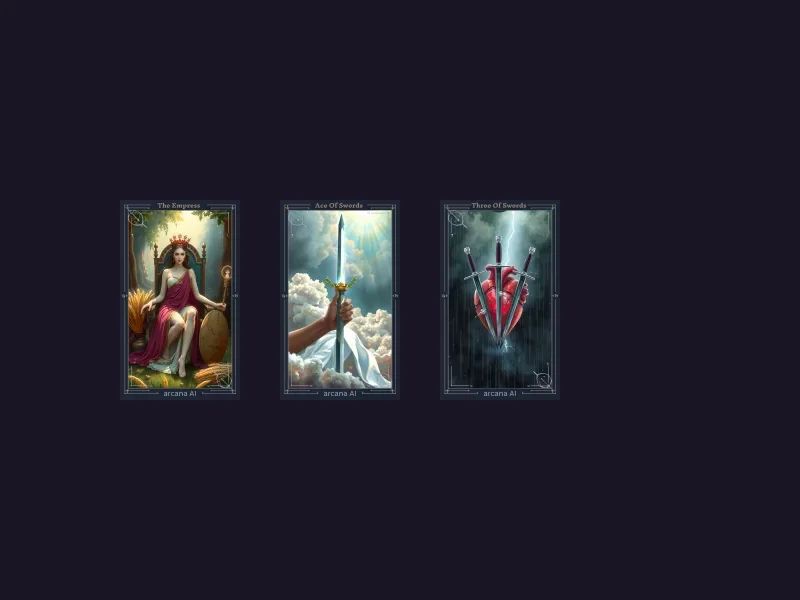
Spread Layout: 3 card(s)
Card Positions
Past
Represents significant events, formative experiences, or previous choices that continue to shape your current circumstances. It reveals the roots of your situation.
Present
Illuminates your current state of affairs, active energies, and immediate choices. It shows where your focus sits right now.
Future
Points toward potential outcomes based on your current trajectory. It shows where circumstances naturally lead if your behavior and environment remain consistent.
What Is the Three Card Tarot Spread?
The three card tarot spread is an adaptable three-position layout used to examine a situation across time, perspectives, or choices. By establishing an immediate narrative arc, this layout helps readers analyze how root causes, active conditions, and future momentum connect.
Most tarot practitioners begin with three cards because the structure strikes an ideal balance. One card can occasionally feel too brief for complex problems, while ten-card layouts like the Celtic Cross introduce excessive variables for everyday queries. Three cards provide enough context to reveal patterns while keeping your interpretation actionable.
15 Versatile Three Card Spread Variations
While the classic timeline is the most famous version, the three card framework adapts to almost any analytical question. Below are fifteen tested variations organized by intention.
1. Timeline and Temporal Progressions
These spreads track momentum across linear time:
- Past / Present / Future: The classic layout. Card 1 shows foundational roots, Card 2 describes current circumstances, and Card 3 projects where momentum leads.
- Current Situation / Near Future / Long-Term Outcome: Focuses on upcoming shifts. Useful when you already understand your past and want to evaluate what happens next month versus next year.
- Morning / Afternoon / Evening: A practical daily rhythm spread. It reveals the prevailing energy for starting your day, handling midday demands, and winding down at night.
2. Decision-Making and Choices
When facing dilemmas, these variations clarify consequences before you commit:
- Option A / Option B / Decision Criterion: Places two competing paths side by side, with the third card showing the core value or standard you should use to decide between them.
- Risk / Reward / Verdict: Identifies the potential vulnerability of a choice, the realistic upside, and practical guidance on whether to proceed.
- Action / Inaction / Likely Outcome: Compares what occurs if you intervene directly versus what unfolds if you let circumstances resolve on their own.
3. Relationships and Interpersonal Dynamics
Use these spreads to unpack partnerships, family friction, or professional collaborations:
- You / The Other Person / The Connection: Card 1 reflects your mindset and expectations, Card 2 shows their perspective, and Card 3 defines the shared dynamic between you.
- Underlying Friction / Common Ground / Constructive Path: Highlights what is triggering conflict, what values you both still share, and a practical step forward.
- What You Need / What They Need / How to Meet in the Middle: Focuses on mutual emotional requirements, pinpointing healthy compromise without compromising boundaries.
4. Self-Discovery and Mindset
These layouts support self-inquiry and personal reflection:
- Mind / Body / Spirit: Explores your mental focus, physical vitality or stress levels, and deeper emotional alignment.
- Conscious Thought / Subconscious Fear / True Reality: Uncovers blind spots by separating what you tell yourself from what you quietly fear, contrasting both with objective reality.
- Current Strength / Blind Spot / Immediate Growth Area: A candid assessment tool for self-improvement and emotional maturity.
5. Career and Problem-Solving
When tackling workplace projects or complex roadblocks:
- Current Situation / The Core Obstacle / Recommended Action: Pinpoints the hidden friction slowing down your project and provides concrete advice to break through.
- Creative Concept / Execution Barrier / Tangible Result: Ideal for artists, writers, and entrepreneurs testing whether an idea has practical traction.
- Current Financial Habits / Hidden Opportunity / Wealth Building Advice: Focuses on material resources, highlighting where money leaks and where disciplined effort will pay off.
Reading the Narrative: How to Synthesize Three Cards
The most common mistake beginners make is reading three cards as three isolated silos. Tarot cards dialogue with each other, and their meaning changes based on their neighbors.
Look for Dominant Suits and Elements
Scan the spread for elemental patterns:
- Majority Wands (Fire): Suggests urgency, passion, and rapid expansion. If matched with swords, expect debate or high-stakes competition.
- Majority Cups (Water): Emphasizes relational matters, vulnerability, and emotional sensitivity.
- Majority Swords (Air): Signals that the issue is primarily mental. You are dealing with analytical scrutiny, communication barriers, or anxiety.
- Majority Pentacles (Earth): Anchors the reading in physical reality, money, schedules, and long-term security.
- Multiple Major Arcana: Indicates that major life lessons or forces beyond your immediate control are at play.
Follow Visual Lines of Sight
Pay close attention to where the figures on the cards are looking. In traditional decks like the Rider-Waite-Smith:
- If the figure in the Past card faces toward the Present card, old habits or past agreements actively influence today’s choices.
- If the Present card turns its back on the Future card, there is hesitation or reluctance to accept upcoming changes.
- If two cards face directly toward one another, they indicate direct confrontation or cooperative alignment.
Case Study: A Career Crossroads Reading in Action
Consider a practitioner asking whether to leave a comfortable corporate position to launch an independent consultancy. Using the Situation / Obstacle / Action framework, they draw:
- Position 1 (Situation): Eight of Pentacles. The querent has spent years honing specialized technical skills through disciplined, steady labor. Their competence is unquestioned.
- Position 2 (Obstacle): Two of Wands. The obstacle is not lack of ability, but hesitation at the threshold. Standing on the battlement looking out at the world, the figure is stuck in planning mode, overanalyzing whether to leave familiar security.
- Position 3 (Action): The Chariot. The card gives clear directional advice. Do not linger indefinitely in deliberation. Harness opposing forces through disciplined willpower, set a launch date, and take command of the venture.
Read individually, these are three fine cards. Read together, they tell a coherent story: mastery has already been achieved (Eight of Pentacles), the delay is purely mental hesitation (Two of Wands), and decisive forward momentum will break the deadlock (The Chariot).
Step-by-Step: How to Perform a Three Card Reading
- Select your framework before drawing: Decide on the exact meaning of all three positions before you shuffle. Never draw cards first and invent the positions afterward.
- State your question clearly: Speak or write your query with a clean timeframe and specific focus.
- Shuffle with intent: Mix the cards until your hands feel a natural pause. Cut the deck into three piles and restack them.
- Lay out the cards from left to right: Place cards 1, 2, and 3 face down in a horizontal row, then turn them face up together to take in the initial visual landscape.
- Synthesize the progression: Check for suit majorities, evaluate the narrative arc, and write down the key lesson before taking action.
Interactive Reflection with Arcana AI
Drawing cards at home provides quiet contemplation, but interpreting nuanced combinations can occasionally leave you second-guessing your intuition. Arcana AI pairs classical tarot traditions with responsive reflection tools.
By analyzing the specific context of your three cards together, Arcana AI identifies subtle thematic ties and elemental tensions across your spread. This gives you structured clarity that supports your own decision-making process.
Frequently Asked Questions About the Three Card Spread
What is a three card tarot spread?
A three card tarot spread is a versatile layout that places three cards in a row to explore a progression. While traditionally read as Past, Present, and Future, the three positions can represent any three-part framework such as Situation, Obstacle, and Advice.
Is the three card spread suitable for beginners?
Yes. It is widely considered the best foundational spread in tarot because it establishes clear relationships between cards without overwhelming the reader with complex geometry.
Can a three card reading answer relationship questions?
Yes. Popular relationship frameworks include You, Partner, and Relationship Dynamic, or Conflict, Root Cause, and Resolution.
How do you read cards together instead of separately?
Look for recurring suits, elemental balances, and the direction characters face on the cards. If two figures turn toward each other, they indicate collaboration; if they look away, they suggest friction or detachment.
Does the future card predict a fixed outcome?
No. The future card reflects the current momentum. If you alter your choices, mindset, or actions in the present position, the trajectory shifts accordingly.
How often can I perform a three card reading?
You can draw three cards daily for morning alignment, or use the spread whenever a specific question or decision requires structured clarity.
Complementary Spreads to Deepen Your Practice
Once you feel comfortable working with three cards, you can explore other focused spreads:
- Yes or No Spread: A fast, single-card consultation for binary decisions that need direct answers.
- Celtic Cross Spread: A ten-card layout providing deep diagnostic insight into complex, multi-layered situations.
- Relationship Spread: A dedicated spread designed to unpack intimate interpersonal dynamics in greater detail.
Example Questions
- What do I need to understand about my current situation?
- How can I find this career transition effectively?
- What underlying dynamics are shaping this relationship?
- What energy should I focus on cultivating today?
- How did this obstacle develop, where does it stand, and how do I resolve it?
Related Spreads
Celtic Cross Tarot Spread: 10-Card Layout & Guide | Arcana AI
The classic 10-card tarot layout providing deep diagnostic insight. Explores conscious and subconscious forces, external conditions, and potential outcomes.
One Card Tarot Spread: Focus Frameworks & Daily Practice
A single card delivers unclouded insight when paired with the right inquiry. Learn focus question frameworks, daily anchor routines, and clear interpretation methods.
Two-Card Tarot Spread: Polarity Analysis & Card Dialogues
A focused two-card layout for resolving dilemmas, contrasting perspectives, and reading fluid dialogue between cards through polarity analysis.
Try This Spread
Experience this spread with Arcana AI
Get the AppFrequently Asked Questions
What is a three card tarot spread?
A three card tarot spread is a versatile layout that places three cards in a row to explore a progression. While traditionally read as Past, Present, and Future, the three positions can represent any three-part framework such as Situation, Obstacle, and Advice.
Is the three card spread suitable for beginners?
Yes. It is widely considered the best foundational spread in tarot because it establishes clear relationships between cards without overwhelming the reader with complex geometry.
Can a three card reading answer relationship questions?
Yes. Popular relationship frameworks include You, Partner, and Relationship Dynamic, or Conflict, Root Cause, and Resolution.
How do you read cards together instead of separately?
Look for recurring suits, elemental balances, and the direction characters face on the cards. If two figures turn toward each other, they indicate collaboration; if they look away, they suggest friction or detachment.
Does the future card predict a fixed outcome?
No. The future card reflects the current momentum. If you alter your choices, mindset, or actions in the present position, the trajectory shifts accordingly.
How often can I perform a three card reading?
You can draw three cards daily for morning alignment, or use the spread whenever a specific question or decision requires structured clarity.